Fast Fashion: Your Wardrobe as a Karmic Map
Fast Fashion: Your Wardrobe as a Karmic Map
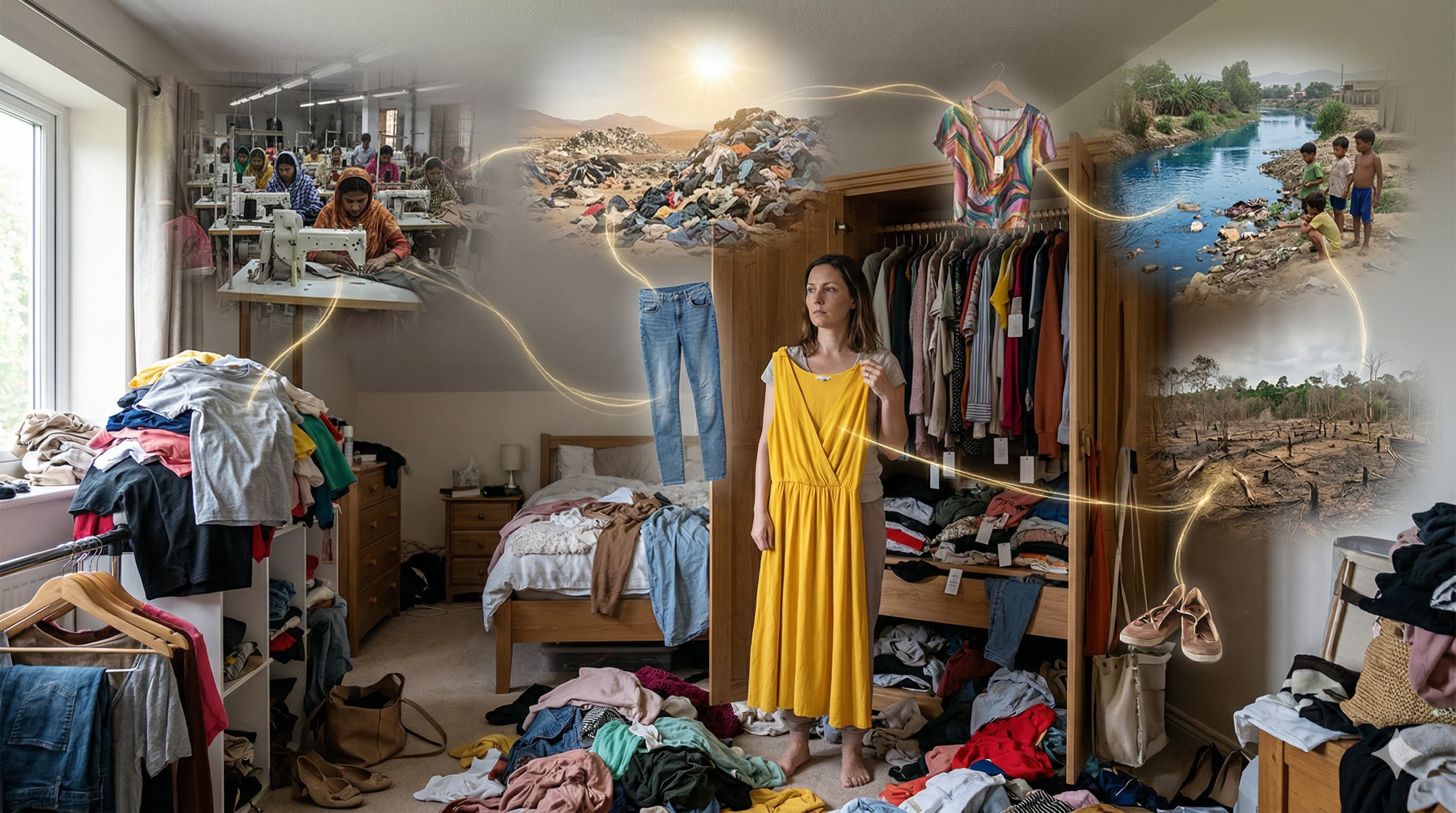
Imagine: you're standing at a rack in H&M or Zara. The shirt costs $8. You try it on, it fits, you take it. Three months later the shirt loses its shape, you throw it away and buy a new one. This cycle seems harmless — until you start pulling on the thread: who made this shirt, and under what conditions? What happens to those billions of tons of discarded clothing? And what is your role in this chain?
Fast fashion is a business model based on ultra-rapid production of cheap clothing that is consumed and discarded. Fashion is no longer seasonal: today major retailers release up to 52 micro-collections per year — nearly one per week. This is not just business. It is one of the most destructive industries on the planet.
The Price of Cheap Clothes: People, Planet, You
Behind an $8 price tag is an invisible cost paid by others — people, nature, and ultimately you.
The Rana Plaza Disaster (2013): The Human Cost of Fast Fashion
On April 24, 2013, the Rana Plaza building collapsed in Bangladesh — an eight-story industrial complex housing garment factories producing clothing for Western brands. 1,134 people were killed; over 2,500 were injured. The day before the tragedy, workers were forced to return to the factory despite visible cracks in the building. The inscription «PLEASE DON'T BUY FROM US» was found in the rubble — written by a worker who knew something would go wrong.
The Rana Plaza disaster became the symbol of the human cost of fast fashion. But it didn't fundamentally change the industry — most brands returned to previous practices within a few years.
92 Million Tons of Textile Waste Per Year
According to the Ellen MacArthur Foundation, the fashion industry produces 92 million tons of textile waste annually — equivalent to a garbage truck packed with clothes every second. Production of synthetic fabrics (polyester, nylon) requires massive amounts of petroleum and creates greenhouse gas emissions comparable to aviation. The textile industry is the world's second-largest water consumer: producing one pair of jeans requires approximately 7,500 liters of water.
Labor Conditions in Manufacturing Countries
The majority of the world's clothing is produced in Bangladesh, Cambodia, Vietnam, Pakistan, and China — countries with minimal labor standards. The average garment worker's salary in Bangladesh is less than $100 per month for a 12-hour workday. 80% of industry workers are women, many of whom face sexual harassment and have no right to unionize.
Gadgets and E-Waste: The Hidden Harm
Fast fashion isn't only about clothing. The same logic operates in electronics: smartphones that «become obsolete» after 2 years, tablets with non-replaceable batteries, laptops with glued-in parts — all of this is planned obsolescence creating mountains of electronic waste.
E-Waste: 53 Million Tons Per Year (UN Data)
According to the UN Global E-Waste Monitor (2019), the world produces 53.6 million tons of electronic waste per year. By 2050, this figure is projected to reach 110 million tons. Only 17.4% of e-waste is officially recycled. The rest goes to illegal dumps in Africa and Asia.
Toxic Materials and Their Impact
Electronic waste contains lead, mercury, cadmium, arsenic, and other toxic substances. When burned or improperly disposed of, they enter soil and water. Studies in Agbogbloshie (Ghana) — one of the world's largest e-waste dumps — showed critical contamination of soil and blood of local residents, particularly children.
Conscious Shopping: Not Prohibition, but Choice
The goal of this article is not to induce guilt, but to create awareness. Understanding the chain behind every purchase means making a truly free choice.
Slow Fashion as an Alternative
«Slow fashion» is the movement opposite to fast fashion. Its principles: less but better; buy ethically made clothing; value quality and durability; repair instead of discard. Slow fashion is not a luxury for the wealthy. It's a matter of priorities: one quality sweater for $80 will last 10 years; ten cheap sweaters at $8 each will last one or two years.
Secondhand and Clothing Rental
Buying secondhand is now a mainstream practice, not a stigma. The secondhand and resale market is growing 3 times faster than the new clothing market (ThredUp, 2023). Renting clothing for special occasions is a smart alternative to a one-time purchase. For the broader context of consumption ethics, read our articles on ecology and karma and ethics of consumption. Also relevant: our article on greed and generosity — how our relationship with money influences consumer choices.
7 Questions Before Every Purchase
These questions are a practical tool for conscious shopping — not a rule, but a filter.
- Do I need this or do I just want it right now? If the answer is «want it right now», wait 24 hours — the desire often passes.
- Do I have something similar at home? Excess items are often invisible until you start making a list.
- Who made this and under what conditions? If you don't know — the brand has no supply chain transparency.
- How long will this last? A cheap item you'll discard in a year costs more per year of use than a quality item.
- What happens to this item when it wears out? Is the material recyclable? Can it be repaired?
- Can I buy this secondhand? Thrift stores, marketplaces, swapping with friends.
- If I'm buying anyway — have I chosen the best available option? Not the ideal, but the best available by the balance of price, quality, and ethics.
Ecological Karma
Your wardrobe is not just clothing. It is a map of your choices. Every item in it speaks to what you've supported with your money. Mindfulness in these choices doesn't require sacrifice — it requires a bit more attention before purchasing. Take the test at karm.top to explore your karma in the «ecology» and «money» categories — consumer choices are part of both.
FAQ
How «conscious» are conscious brands actually? It's critical to distinguish between genuine sustainability and «greenwashing». Look for specific data: GOTS (organic textiles), Fair Trade, or B Corp certifications. Vague claims of «we're eco-friendly» without data are a red flag.
What about the clothes already in my wardrobe? Use them to the fullest! The most ecological thing is to wear what you've already bought as long as possible. Discarding «unconscious» purchases and replacing them with «conscious» ones is not a solution — it's a double ecological burden.
How do I explain conscious shopping to children? Through concrete examples: «This shirt was made by a person. Do you think they had good conditions to work in?» Children often understand ethics intuitively — better than adults who have suppressed it.
Subscribe to new content
We publish articles about karma, self-discovery and spiritual practices. No spam — only the good stuff.
We never share your email with third parties. Unsubscribe anytime.