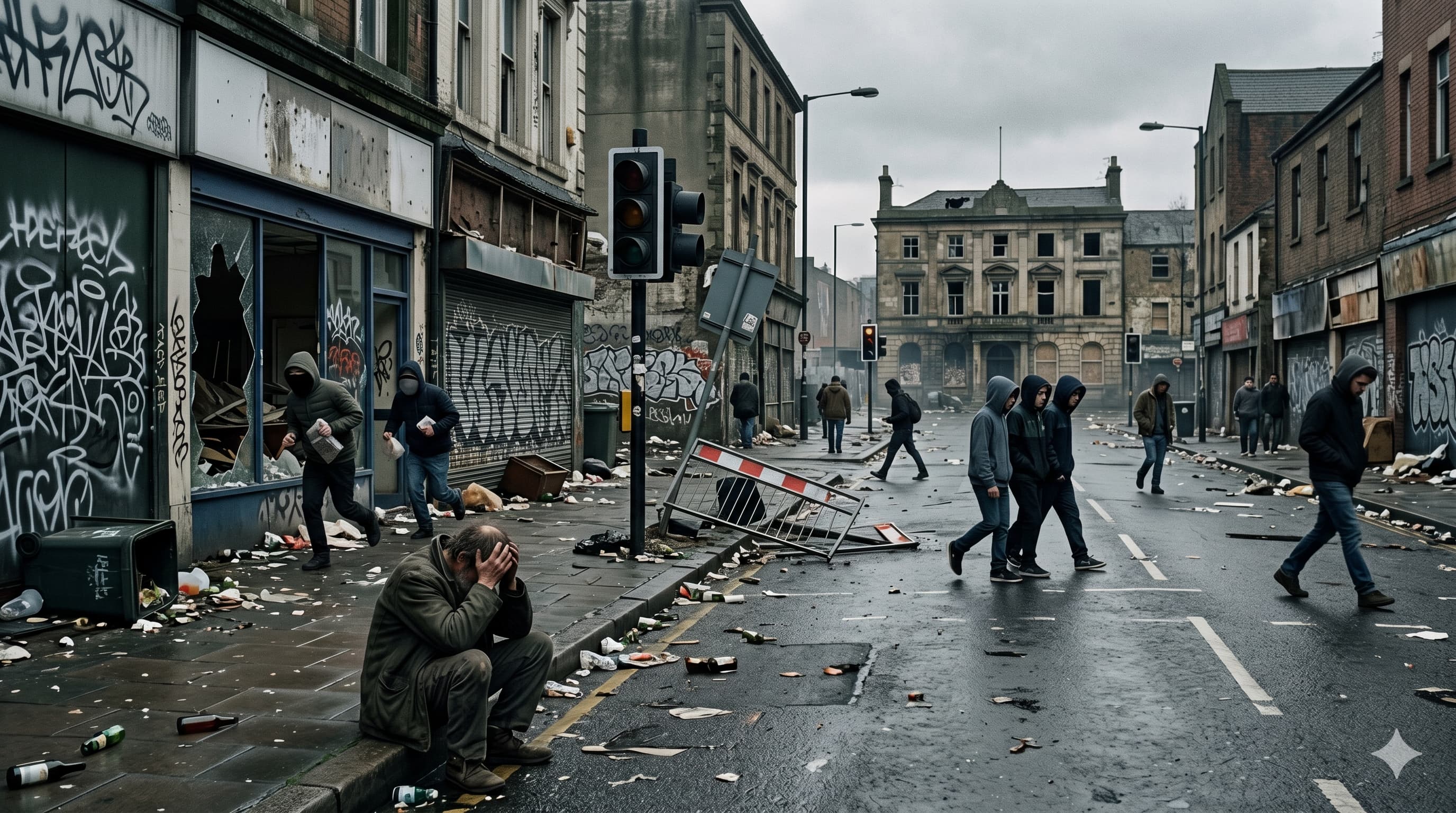
The Karma of Anomie: What Happens to Society When Norms Collapse
Something strange has been happening in the 2020s. The rules that once seemed fixed — not just laws, but social norms, the shared understandings that govern everyday life — have started to feel negotiable. One person is convinced that wearing a mask on public transit is basic courtesy; another considers it paranoia. One person thinks not answering work emails on weekends is healthy self-care; another sees it as professional failure. Everyone seems to be playing by a slightly different version of the rulebook — and each player is sincerely convinced that their version is the only reasonable one. This experience is widespread, deeply disorienting, and old enough to have a name. Sociologists call it anomie.
Durkheim's Uncomfortable Discovery
Émile Durkheim introduced the concept of anomie in the late 19th century while studying suicide rates across European societies. His finding was counterintuitive and, for many readers at the time, deeply strange: suicide rates rose not only during economic crashes but also during periods of sudden prosperity. The logic seemed inexplicable until Durkheim offered the key: both collapse and rapid growth destabilise the norms that tell people what to want, what to expect, and how to evaluate their lives. Social anchors disappear.
Anomie, for Durkheim, was not simply lawlessness. It was a state of normative vacuum — when social regulators, the informal norms and shared expectations that govern behaviour, weaken to the point where individuals lose external reference points. You might think this would feel like freedom. It does not. The atomised person left alone with infinite possibility but without a coordinate system experiences not liberation but anxiety. Unlimited choice without criteria is not a gift; it is a form of suffering.
Robert Merton extended the concept in the 1930s with a structural version. Anomie arises, Merton argued, when cultural goals — what society teaches people to want: success, prosperity, recognition — diverge from the institutional means available for achieving them. When everyone is supposed to want the American dream but legitimate pathways to it are available only to some, people either seek illegitimate routes or simply withdraw from the game altogether, becoming what Merton called "retreatists." This framework explains much: the relationship between inequality and crime, the roots of social apathy, and the appeal of nihilism as a worldview.
Anomie in Transition Periods
Sociologists consistently find anomie spikes in three contexts: migration, social upheaval, and technological transformation. All three are currently operating simultaneously, at unprecedented scale and speed.
Migrants navigating between two normative systems inhabit a particularly vivid form of normative limbo. The old rules don't apply in the new context — what was courtesy has become intrusiveness; what was modesty has become passivity. The new rules aren't yet embodied — understood intellectually but not yet felt instinctively. Research published in journals such as Social Psychology Quarterly and Transcultural Psychiatry consistently documents elevated rates of anxiety, depression, and social disorientation in the first years after relocation. This is not because migrants are psychologically fragile; it is because normative ambiguity is genuinely and measurably stressful.
Digital transformation has produced a novel and historically unprecedented form of anomie. Online culture evolves faster than norms can form. Every few years, a new platform emerges with its own unwritten rules — and nobody publishes a manual. What's appropriate to post and what isn't? How should you respond to harassment — ignore, engage, block, or report? Can someone you've never met offline be a genuine friend? Is it acceptable to research someone's old posts before meeting them? These questions may seem trivial in isolation. The absence of shared answers to them generates persistent, low-level tension that accumulates across years without ever reaching a crisis point that might force resolution.
Social upheavals — wars, revolutions, pandemics — concentrate anomie into acute episodes. When a familiar order collapses within weeks, people discover that their previous norms were not universal laws of nature but specific products of specific social conditions. This realisation is itself disorienting — even when the new conditions turn out to be better than the old ones.
What Anomie Feels Like from the Inside
At the individual level, anomie produces recognisable psychological patterns. Researchers describe three predominant responses — all of which can feel, from the inside, like reasonable reactions to a difficult situation.
Anxiety and decision paralysis. When norms are unclear, every decision requires enormous cognitive effort — because you can't simply do "what's done." What's done is precisely what's unclear. This generates chronic decision anxiety and, in more extreme cases, complete avoidance of choices. Studies show that under conditions of high normative uncertainty, people delay decisions more frequently, seek authoritative guidance more readily, and respond more strongly to any signal of social consensus, however weak.
Nihilism as psychological defence. A second response is to conclude that if there are no shared rules, anything goes — or, in a more intellectually elaborated form, that since all norms are social constructs, no action carries objective moral weight. Nihilism reduces anxiety by eliminating the need to justify behaviour to oneself. But it does so at the cost of disabling the internal moral regulator. Someone who has stopped monitoring whether their actions align with their values loses a crucial feedback mechanism.
Hyperconformism and the search for structure. The third response is to cling rigidly to any available normative system. Religious fundamentalism, ideological extremism, and various forms of ultra-orthodoxy are often less about genuine conviction than about the need to escape normative vacuum. If the external world provides no reliable guides, build your own perfectly clear world where everything has a place and every action has a ready evaluation. This works — until reality presents cases that don't fit the system.
How Norms Rebuild at the Micro Level
Anomie is never permanent. Not because societies automatically stabilise but because humans are social animals who reconstruct norms wherever old ones have been destroyed. This happens from the bottom up: first in families, teams, and small communities — and only later, if conditions are favourable, at the level of society as a whole.
Organisational behaviour research establishes something important: teams that explicitly discuss their working norms — "here we respond within the day," "we don't interrupt in meetings," "we say directly when we disagree" — are substantially more productive and resilient than teams that leave norms implicit. This seems obvious in retrospect. Yet most groups never do this deliberately. Norms form spontaneously, through imitation — and they frequently reproduce the worst available patterns rather than the best, since bad behaviour is often more visible and emotionally salient than good.
At the family level, the same principle applies. Psychologist John Gottman's longitudinal research with hundreds of couples over decades found that stable relationships are distinguished not by the absence of conflict but by the presence of explicit, shared "family rules" — about how to discuss money, how to handle holidays, how to express dissatisfaction without destroying closeness. These norms form gradually through hundreds of small interactions and require periodic renewal as life changes.
Online communities provide a natural experiment. Communities with explicitly articulated rules — what can be posted, how discussion should proceed, how newcomers should be treated — maintain healthier cultures over time than those that leave norms implicit, even when explicit rules initially seem over-regulated. A norm that nobody has articulated still exists; it is simply set by whoever is loudest or most aggressive.
The Karma of Being a Norm-Setter
This is where the concept becomes personally consequential. In conditions of anomie, your personal standards acquire disproportionate weight. When there is no general standard, people orient themselves by observing others — especially those they respect, spend time with, or observe in situations similar to their own.
This is the social anchor effect, documented across multiple areas of social psychology. Your behaviour becomes an implicit reference point: "Ah, so this is how things are done here." If you permit yourself small dishonesty in front of colleagues — slight exaggerations, convenient omissions — you imperceptibly shift their sense of the norm. If you remain calm and respectful in a difficult conversation, that too becomes an implicit standard. If you do what you promised while others are being cynical, you create a counter-narrative.
Psychologists distinguish "normative influence" from "informational influence." Informational: you observe someone more competent and extract information from them. Normative: you observe how someone behaves and this becomes a guide for your own behaviour — even without your awareness. Solomon Asch's classic experiments showed that people give obviously incorrect answers under social consensus pressure — not because of low intelligence but because of a deep need for normative agreement. In periods of anomie, normative influence intensifies precisely because the deficit of norms heightens sensitivity to any signal of "how things are done."
This is the karma of the norm-setter: you create norms, and you live in a world you have partly shaped. Kohlberg's framework of moral development describes precisely this transition — from following others' norms to constructing one's own. That is the maturity anomic periods most demand.
Practical: Anchoring Yourself When the Social Map Is Unreliable
If external norms are unstable, the only reliable anchor is internal. But internal anchors don't form automatically — they require deliberate construction. Here is what the research suggests actually works.
A moral compass creates an internal reference point when the external one has disappeared. Psychological research on value clarity consistently finds that people with a clear sense of what they value and why are substantially more resilient under normative pressure and in conditions of anomie. They don't wander in search of norms because they already carry them.
- Make your values concrete. Not "I try to be honest" but "For me, honesty means: I won't withhold information that matters to another person, even when that's inconvenient for me." Abstractions are easy to override in moments of temptation. Specific behavioural commitments are substantially harder.
- Distinguish norms from values. Norms are "what's done in this context." Values are "what matters to me regardless of context." In conditions of anomie, norms are unreliable; values are a more stable foundation precisely because they don't depend on what others are doing.
- Find communities with explicit norms you genuinely respect. Not any norms — norms that align with what you care about. Professional associations, volunteer organisations, local communities. Belonging to such a group provides normative support without requiring constant reinvention.
- Track your acute reactions. What genuinely disturbs you — not because "it isn't done" but because it violates something deeper? Those reactions point to your actual values, as distinct from the ones you'd list on a survey.
- Name norms aloud — in teams, in families. Not as rules from above but as proposals for discussion: "It matters to me that we have a norm of..." This feels awkward at first. It is nonetheless how living norms form, rather than dead regulations that everyone ignores.
Anomie is not pathology. It is the normal condition of transitional periods, and it always resolves into new norms. The question is who creates those norms — spontaneously or deliberately — and what kind they are. The answer is partly you. Curious where your inner compass currently points? Exploring your moral compass is a good place to start.
Subscribe to new content
We publish articles about karma, self-discovery and spiritual practices. No spam — only the good stuff.
We never share your email with third parties. Unsubscribe anytime.