The Karma of News Consumption: How Media Shapes Our Karma
Imagine that every morning at breakfast you eat a bowl of toxic chemicals. Absurd? But that is precisely what most of us do when we open the news feed. Researchers at the University of Essex in 2013 showed that viewing three minutes of negative news in the morning increases the probability of a "bad day" by 27%. We consume information without thinking about its impact — just as people didn't think about the harm of secondhand smoke half a century ago. But information diet shapes our karma just as surely as food diet shapes our health.
How Our Brain Responds to Bad News
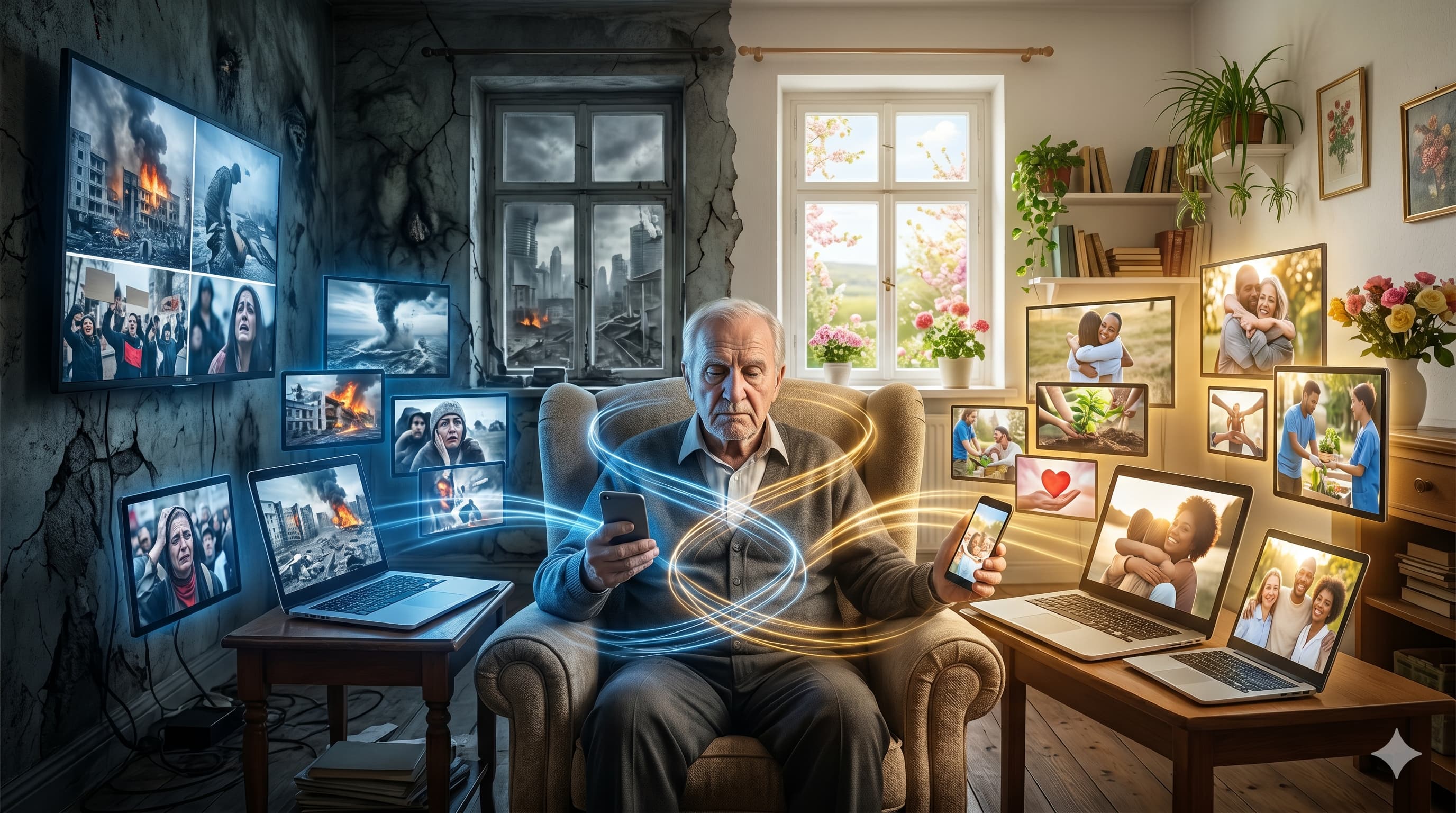
The brain does not distinguish between an imagined threat and a real one. When you read about a disaster on the other side of the planet, the amygdala responds as if the threat were right here, right now. A surge of cortisol and adrenaline, narrowing of attention, switching into "fight or flight" mode — all of this happens physically, in your body, even when the threat is thousands of kilometers away.
Neuroscientist Daniel Levitin, in "The Organized Mind," describes why the news stream is particularly dangerous: it exploits the evolutionary mechanism of the "orienting reflex" — the instinctive response to anything new, unexpected, and potentially threatening. Media have learned to create content that constantly activates this reflex, holding us in a state of chronic vigilance.
German neuroscientist Manfred Spitzer introduced the term "digital dementia" to describe the cognitive changes occurring with intensive consumption of digital content, including news. Not because the internet is "bad" — but because constant attention switching, interrupted streams, and the absence of deep immersion structurally change how the brain processes information.
Ask the Oracle how your information diet is affecting your current state of mind.
The Karmic Effect of Information Violence
"If it bleeds, it leads." This principle, known to American television producers since the 1970s, describes the fundamental commercial logic of mass media. Bad news sells better than good news — five times better, according to a 2019 University of Montreal study. This means that an industry that lives on attention has a vested interest in making the world appear to be a frightening place.
Dr. Graham Davey at the University of Sussex researched the effects of negative news on anxiety and found that even brief consumption intensifies worry, catastrophizing, and worsens mood — and these effects are not neutralized by time. Regular consumers of negative news have a higher baseline cortisol level, a more pessimistic view of the world, and less willingness to help others.
It is this last finding that is most karmically significant. Media psychologist Ziyad Marar found that chronic consumption of news about suffering leads to "compassion fatigue" — a state in which a person stops emotionally responding to others' pain. Paradoxically: the more we are "informed" about the world's problems through news — the less capable we become of genuine altruistic action.
From a karmic perspective, this means: regular consumption of violent, anxiety-inducing, or hateful content literally makes us less kind, less compassionate, and less capable of meaningful action. This is not a moral argument — it is neurobiology. Evaluate your patterns in the karma test.
Passive Consumer vs Active Citizen
There is a temptation to think: "If I don't follow the news, I'm an irresponsible citizen." But this is a false dilemma. There is a fundamental difference between uncontrolled consumption of the news stream and conscious receipt of information needed for civic participation.
Researchers from Oxford, as part of the Reuters Digital News Report 2023, documented an interesting phenomenon: people who deliberately limit news consumption (so-called "news avoiders") are, on average, no less informed about key events than active consumers. They simply receive information more purposefully — through trusted sources, on specific topics.
Moreover: political scientist John Zaller, in his research, showed that hyperinformed citizens who follow all the news do not make better-considered political decisions — on the contrary, they are often more susceptible to polarization, because they constantly consume content that amplifies their biases.
The karmic position of an active citizen is not "follow everything" but "act consciously." The difference between "I know about the climate crisis from 50 articles a week" and "I know about it from 5 deep pieces and take concrete action" is enormous. The second approach is karmically more valuable.
How to Choose Information Consciously
Conscious information consumption is a skill that requires practice. Here are several principles:
The "dosage" principle. Set a fixed time for news — for example, 20 minutes after lunch. Outside of that time, news mode is off. Research shows that structured news consumption reduces anxiety by roughly a third while maintaining the same level of awareness.
The source diversity principle. Psychologist Eli Pariser, in "The Filter Bubble," described how algorithms create information bubbles, showing us only what confirms our views. Consciously escaping the bubble requires effort: reading sources with different political perspectives, seeking out uncomfortable facts, cross-checking the same event across multiple outlets.
The "depth layer" principle. Prefer analytical pieces over news feeds. One deep article provides understanding — ten tweets generate noise. Explanatory journalism — such as Vox, The Conversation, or similar — provides context that standard news lacks.
The "what will I do with this" principle. Before consuming any content, ask yourself: what am I going to do with this information? If there is no answer — perhaps you don't need it. Read more about digital detox in our article "Digital Detox."
News Detox: Temporary and Permanent
The term "information detox" entered professional discourse in the early 2010s. Initially viewed with skepticism — as a sign of social irresponsibility. Today it is backed by substantial research.
A 2022 University of Exeter experiment: participants who abstained from news for a week showed significant reductions in anxiety and mood improvement, with no measurable decrease in awareness of key topics. Similar results have been obtained in dozens of studies worldwide.
Temporary detox is a "reset" of sensory load and an exit from the state of chronic vigilance. It is useful to do this regularly: a week per quarter, or at least a news-free weekend. This is not an escape from reality — it is perceptual hygiene.
Permanent "detox" is a change in one's relationship to information itself. Accepting that it is impossible to know everything, follow everything, and respond to everything — and that this is normal. Choosing a few areas in which you are genuinely competent and active, instead of anxiously monitoring everything. This is a mature and karmically healthy position.
Read about the connection between digital environment and karma in our article "Digital Karma."
The Practice of Information Hygiene
Here is a concrete information hygiene protocol you can implement right now:
- "Morning Quarantine": The first 60-90 minutes after waking up — no news. This is time for the morning ritual, breakfast, reflection. News that truly matters will not disappear in an hour. And your brain gets the chance to start the day from a state of calm, not anxiety.
- "Evening Deadline": Do not read news for two hours before sleep. Emotionally charged information disrupts sleep — and this is not a metaphor, but physiology. Cortisol released in response to stressful news interferes with falling asleep and reduces sleep quality.
- "Curated Sources List": Compile a list of 5-7 sources you trust. Read only these regularly. Everything else — as needed. This radically reduces information noise while maintaining quality.
- "Three-Day Rule": Before sharing a news item or making a judgment about an event — wait three days. By then, initial hysteria will have subsided, and clarifications and context will have emerged. Most "breaking news" turns out to be less significant or fundamentally different three days later.
- "Local Focus": Deliberately increase the proportion of information about your immediate community — your city, neighborhood, professional sphere. This is the information you can actually do something with. Global news creates the illusion of participation without the possibility of action. Local information creates genuine opportunity for influence.
Read about the connection between fakes and karma in our article "Fakes, Misinformation, and Karma."
The karma of news consumption is not an abstraction. Every time you choose anger instead of understanding, fear instead of action, passive watching instead of conscious participation — you form a pattern that accumulates. And conversely: every time you make a conscious choice in favor of information quality, its verification, and genuine action based on it — you take a step toward the karma you want to have. Information is fuel. You choose what to burn.
Subscribe to new content
We publish articles about karma, self-discovery and spiritual practices. No spam — only the good stuff.
We never share your email with third parties. Unsubscribe anytime.