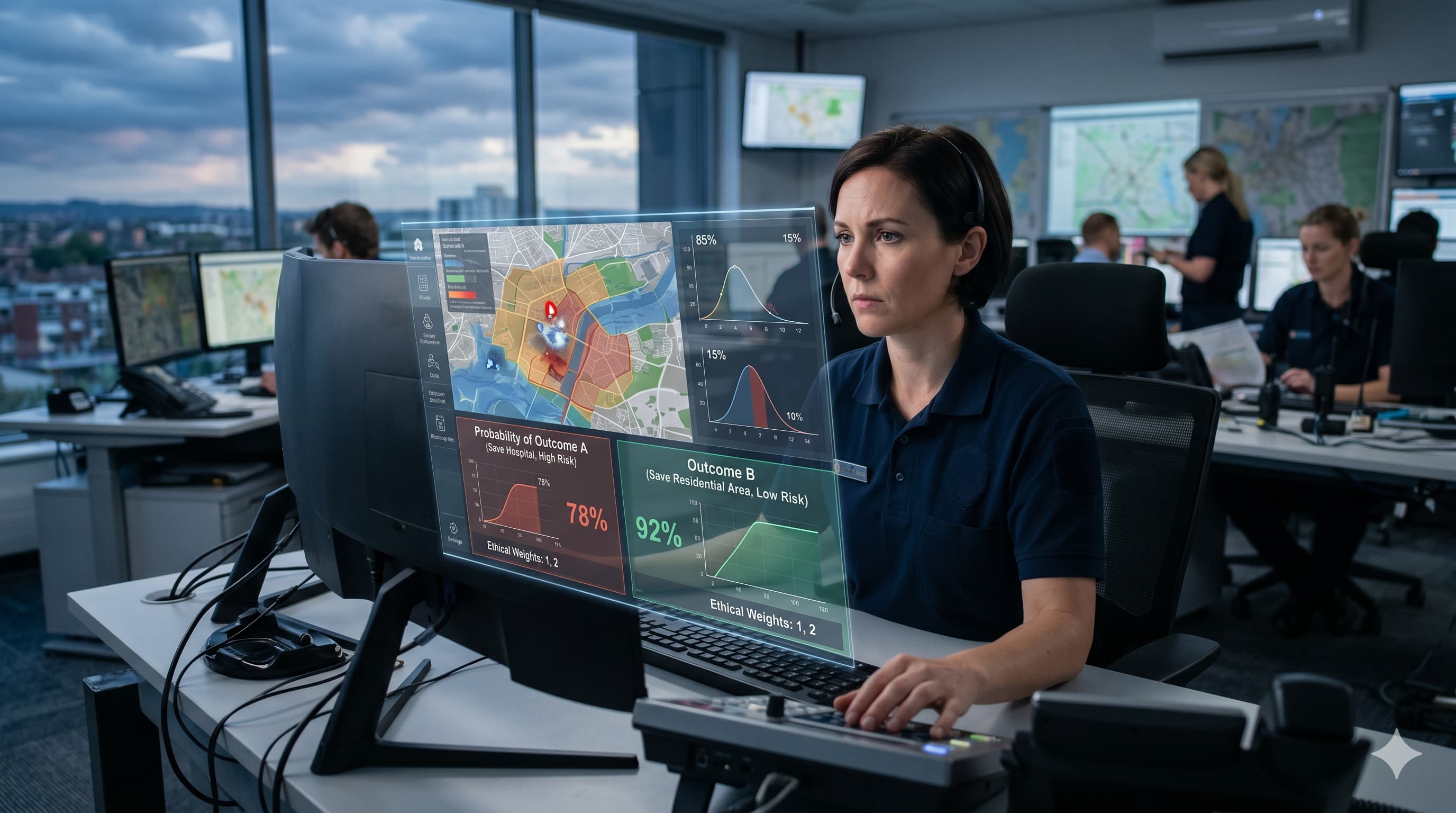
The Karma of Probabilistic Thinking: How Statistical Reasoning Changes Ethical Choices
You are probably more afraid of plane crashes than car accidents — even though the latter are statistically about 95 times more dangerous. You likely worry more about rare terrorist attacks than about chronic physical inactivity — though the latter kills people at a rate roughly a million times higher. Our brains are poorly equipped to handle probabilities. And this has direct ethical consequences: we make decisions based on fears that bear little relationship to actual risk.
Why Humans Are Bad at Probability: The Availability and Affect Heuristics
In a series of experiments in the 1970s, Daniel Kahneman and Amos Tversky described the availability heuristic: we estimate the likelihood of an event by how easily examples come to mind. Plane crashes receive extensive media coverage — so the brain treats them as frequent. Cardiovascular disease from sedentary living kills quietly, one person at a time — so the brain barely registers it.
Working alongside availability is the affect heuristic: when something triggers fear or disgust, we automatically overestimate its probability and underestimate its benefits. Nuclear power frightens people far more than coal power — even though coal kills hundreds of times more people per unit of energy produced. These cognitive errors are not signs of stupidity. They are embedded in the architecture of fast thinking, a system evolved for threats very different from the ones we actually face.
The ethical dimension is direct: if your risk assessments are systematically distorted, your moral decisions — about who to help, what to fight for, what to avoid — are distorted in turn.
Tetlock's Superforecasters: What Makes People Unusually Accurate Predictors
In 2015, political scientist Philip Tetlock published results from a large multi-year study: in competition to predict geopolitical events, some participants consistently outperformed others — including classified CIA analysts with access to secret information. Tetlock called them superforecasters.
What distinguished them? Not IQ, not educational credentials, not information access. What distinguished them were specific cognitive habits:
- They thought in numbers. Not "probably" or "unlikely," but "I estimate this at 65%" or "roughly 20% probability."
- They updated their beliefs readily when new data arrived — quickly, and without ego.
- They were calibrated: when they said "70% probability," the event happened approximately 70% of the time.
- They decomposed large questions into smaller, estimable components.
- They actively sought out the opposing view.
Critically: superforecasters were not always right. They were right in proportion to their stated confidence — and that is a fundamental difference.
The Karma of Certainty: How Overconfidence Causes Harm
Tetlock's research revealed the dark mirror: overconfidence correlates with harm. High-profile media experts — the analysts invited onto talk shows as authoritative commentators — predicted, on average, worse than educated amateurs without media access. The reason: highly confident forecasters failed to update their beliefs when disconfirming data arrived.
The ethical consequences are concrete. A physician convinced of their diagnosis skips additional tests — and misses a rare but lethal alternative. A politician certain of their policy's correctness ignores warning signals — and leads a country into crisis. A manager certain of their decision suppresses dissent — and loses critically important information.
Overconfidence is not merely a cognitive error. It is a moral problem: it closes us off from others' realities and makes us insensitive to the consequences of our actions.
Calibrated Uncertainty as an Ethical Practice
"I might be wrong" is not weakness. In the context of probabilistic thinking, it is one of the most powerful and ethically significant statements a person can make.
Calibrated uncertainty means that your degree of confidence matches the strength of your evidence. This enables you to: remain open to updating your position without losing the ability to act; hear those who disagree more clearly — because their disagreement contains information; make fairer decisions about other people, without condemning them with unearned certainty.
Research on moral reasoning finds that people with high epistemic humility — the capacity to acknowledge uncertainty — make more considered ethical decisions in complex situations. They are less likely to succumb to deontological rigidity ("this is always wrong") or utilitarian simplification ("the end justifies the means") — and more likely to perceive nuance. This connects to how the Oracle works as a tool for reflection, not prediction: the value lies not in the answer but in the quality of the question.
Applications: How to Think Probabilistically About Risk, Blame, and Possibility
Probabilistic thinking reshapes three core domains of ethical decision-making:
Risk assessment. Instead of "dangerous / safe" — "how likely, and how severe?" This allows more accurate allocation of attention and genuine care for yourself and others. Fears shaped by cognitive biases and morality often divert us from actual threats.
Attribution of blame. Most events are not the product of someone's malicious intent but the outcome of many interacting probabilities. When something goes wrong, the question "whose fault is this?" is often less useful than "what factors made this likely?" This does not dissolve accountability — it makes accountability more precise and less empty.
Evaluating possibilities. Most people are prone to the psychology of self-deception: we overestimate the chances of projects we like and underestimate those that trigger scepticism. Probabilistic thinking helps detect this asymmetric optimism and correct for it.
4 Mental Habits of Superforecasters You Can Build
Tetlock and his team identified concrete practices that can be trained:
- Think in numbers. Every time you say "probably" or "unlikely," add an internal question: "Is that 60%? 80%? 30%?" Attaching numerical estimates forces your brain to work more precisely.
- Keep a prediction journal. Record forecasts with dates and confidence levels. Every quarter, check how often your "70% confident" calls actually materialise at a 70% rate. Most people discover they systematically overestimate their accuracy.
- Decompose questions. "Will I succeed at this project?" is too large a question. Break it down: "What is the probability of securing funding? Of the key partner agreeing? Of the market responding as I expect?"
- Seek disconfirming information. Before sharing a belief, spend one minute actively searching for arguments against it. This simple step statistically improves the quality of judgements.
Practical Takeaways
Probabilistic thinking is not merely an analytical tool. It is an ethical practice, because the quality of our judgements directly shapes the quality of our actions toward other people. When we fear the wrong things, we sacrifice for the wrong threats. When we are too certain, we stop listening. When we remain calibrated — we remain open to reality. The karma test is one way to notice where your stated beliefs diverge from your actual choices.
Subscribe to new content
We publish articles about karma, self-discovery and spiritual practices. No spam — only the good stuff.
We never share your email with third parties. Unsubscribe anytime.