The Karma of Chosen Family: Why the Bonds We Create Matter as Much as Blood
There's a phrase that seems obvious until you start testing it: "blood is thicker than water." It implies that biological kinship creates a special, irresistible bond — stronger, more obligating, more real than any other. But the data suggest something different. Research on centenarians, attachment psychology, and the sociology of support networks shows that the quality of a bond is determined not by genetics but by behavior. And behavior is a choice. This means the family you build through your actions can be more real — in the most important sense of that word — than the one you were born into.
The History of Chosen Family: From LGBTQ+ Communities to Global Migration
The concept of "chosen family" gained sociological attention primarily in LGBTQ+ communities — especially in the 1980s and 90s, during the AIDS epidemic in the United States. When biological families rejected dying sons and daughters, their friends, partners, and community became the real support system — caring for the sick, organizing funerals, preserving memory. Sociologist Kath Weston described this in her book "Families We Choose" (1991) as a complex alternative kinship system no less obligating than the biological one.
But chosen families formed not only in marginalized communities. Global migration created entire cultures of "substitute families": when someone moves far from their biological family, they inevitably build a new network of close relationships — with neighbors, colleagues, friends. Japanese tradition has the concept of "ningen" — the human being as by definition a being within a web of relationships, not an autonomous individual. Family in this understanding is a network of mutual obligations that can be built consciously.
Biological vs. Chosen Support: What Predicts Health and Longevity
The famous Harvard Study of Adult Development, begun in 1938 and ongoing, is one of the longest-running studies of human happiness and health. Its central finding, articulated by Robert Waldinger in a viral TED talk: "Good relationships keep us happier and healthier. Period." The key word is "good," not "biological."
Research shows that loneliness is physiologically toxic: chronic social isolation is associated with elevated cortisol levels, impaired immune function, and increased mortality comparable to smoking 15 cigarettes a day. But the key protective factor is not the presence of biological relatives — it's the presence of people you trust and can turn to for support in difficult moments.
A separate study (Chopik, 2017), covering nearly 300,000 people in 100 countries, found that among older adults, friendship predicted health and happiness better than the quality of family relationships. Chosen bonds proved a stronger predictor of wellbeing than inherited ones — especially in later life.
The Karma of Mutual Obligations Without Legal Frameworks
One of the most challenging aspects of chosen family is the absence of legal and social infrastructure. Biological relatives and legal spouses have rights to access medical information, participate in decision-making, and inherit. For chosen family, these rights don't exist by default.
This creates real practical problems: the person you consider closest may be denied the ability to be present at a critical moment without appropriate legal documents. LGBTQ+ activists spent decades pursuing legal frameworks to recognize these bonds — and where they succeeded, the quality of life for vulnerable groups measurably improved.
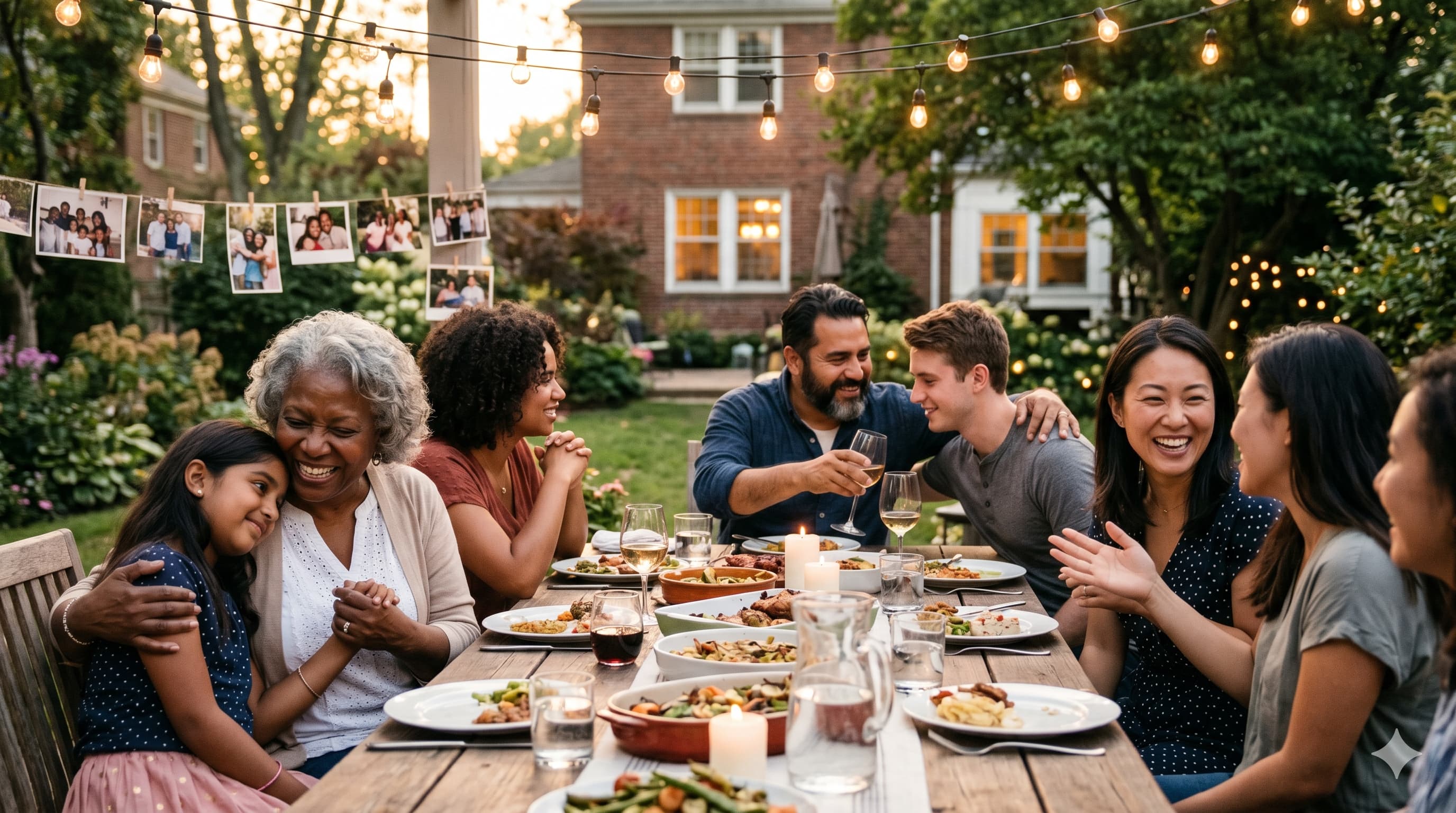
But even without legal frameworks, chosen families function — through informal norms of reciprocity, through trust, and through what sociologists call "diffuse solidarity": willingness to help without keeping an exact account, without expecting immediate return. This requires maturity — and creates special value. No one stays in a chosen family out of obligation by birth. Everyone stays because they choose to stay. This makes every "I'm here" more meaningful.
If you're interested in exploring the quality of your connections, the friends section helps you see the picture of your social network in a new way.
When Chosen Family Fractures
The loss of a chosen family is a particular kind of pain that often isn't recognized by society the way loss of biological relatives is. "They're just friends" — a phrase people hear after painful ruptures with those they considered family. There are no mourning rituals, no bereavement leave, no social recognition of the scale of the loss.
When a chosen family breaks apart — through relocation, conflict, or betrayal — it can be a genuine loss comparable to divorce or losing a close relative. This is especially painful for people who built chosen family as an alternative to a rejecting biological one — when this "second family" breaks down, the person is left with no support network at all.
It matters not just to name this loss as grief, but to give it space. This connects to the topic of friendship and trust — about building bonds that withstand the test of time.
Building a Chosen Family Intentionally
What makes chosen bonds durable? Social network researchers and psychologists identify several key factors.
First — intentionality. Chosen bonds require active maintenance: biological relatives in childhood are present "automatically," chosen ones only if both sides put in effort. This means scheduling regular meetings, initiating contact, making the bond a priority in your calendar.
Second — reciprocity without scorekeeping. Relationships that keep exact tallies of "who gave how much" don't survive crises. Durable bonds are based on diffuse reciprocity: each gives as able, each takes as needed — at different times, in different proportions.
Third — navigating difficulties together. Research shows that bonds that have gone through shared stress, crisis, or vulnerability become significantly stronger. Shared hardship creates a particular kind of closeness impossible to achieve through good times alone.
Fourth — having rituals. Families — biological and chosen — are strengthened through recurring practices: traditional gatherings, shared birthdays, trips, regular calls. Ritual makes the bond visible and physically embodied.
Practice: Mapping and Strengthening Your Chosen Family Network
An exercise for understanding and strengthening your chosen family:
- Draw the map. Draw concentric circles. At the center — you. In the first ring — people you'd call at 3am in an emergency. In the second — people you communicate with regularly and trust. In the third — people from your wider network with whom there is genuine reciprocity. Who is in these rings?
- Check the balance. Are there people you give more to than you receive from? People you take more from than you give to? This doesn't mean imbalance is bad — but awareness of it matters.
- Name the gaps. What's missing in your current network? Who can you tell about a failure without fear of judgment? Who will show up to help you move? Who will be there if you become seriously ill?
- Take one action. Choose one connection you want to deepen and initiate a specific interaction — a meeting, a conversation, a shared project.
A few questions for reflection: Are there people you consider family though they're not biologically related to you? What makes those bonds feel like family? Are there people in your life who need you to become part of their chosen family? How do you maintain the most important non-kin bonds in your life? What prevents you from building deeper chosen connections?
The Neuroscience of Belonging: What Happens in the Brain
The neuroscience of belonging shows why the quality of relationships, not their biological status, determines health. The neurotransmitter oxytocin — often called the "bonding hormone" — is released in any trusting contact: not only with biological relatives, but also with close friends, partners, mentors. Its levels correlate with a sense of safety, reduced anxiety, and willingness to cooperate.
Research by John Cacioppo (University of Chicago) showed that chronic social loneliness elevates cortisol levels, impairs immune response, and accelerates cognitive aging. But the key variable is the subjective sense of connection, not the objective presence of relatives. Someone with a large family in which they feel no acceptance is physiologically more lonely than someone with a small but genuine network of chosen intimates.
This explains why rupture with chosen family is biologically as painful as the loss of a biological relative: the brain doesn't distinguish between "official" and "unofficial" close relationships. It responds to the loss of attachment as a survival threat — activating the same neural pathways as physical pain.
An important additional thought about time and chosen family: unlike biological family, which forms in childhood and is often passively accepted, chosen family can be renewed at different life stages. A move to a new city, a career change, the birth of a child, retirement — each major life transition provides an opportunity to intentionally build a new network of intimates. Research shows that people who remain open to forming new deep bonds in adulthood and older age demonstrate higher levels of cognitive functioning and suffer significantly less from depression and anxiety. Chosen family is not a single attempt. It is a lifelong practice.
Subscribe to new content
We publish articles about karma, self-discovery and spiritual practices. No spam — only the good stuff.
We never share your email with third parties. Unsubscribe anytime.