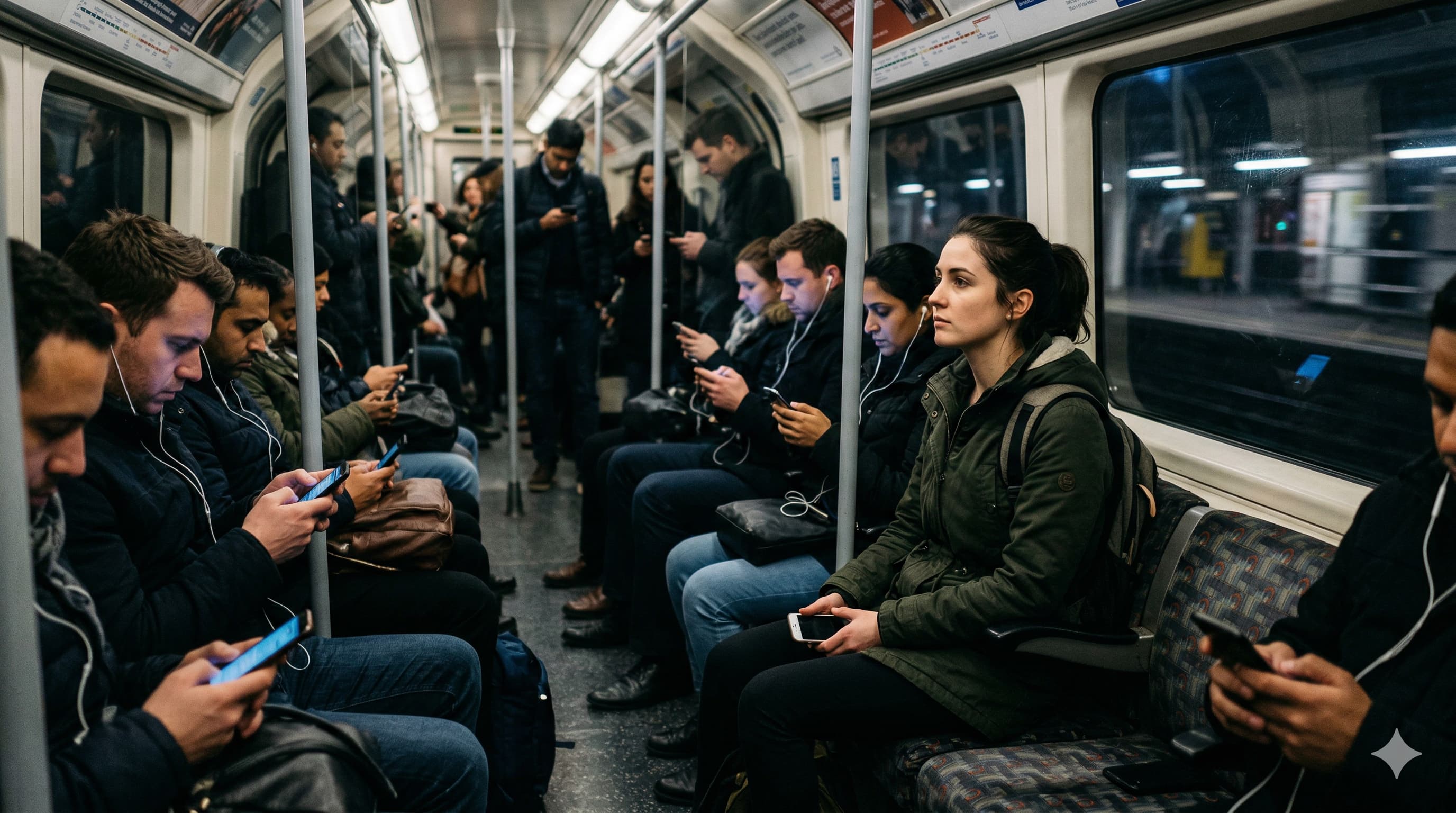
Loneliness in the Age of Hyperconnectivity: The Paradox of Our Time
The Loneliness Epidemic: Data and Scale
We live in an age when humans have never been more «connected» to others: messaging apps, social networks, video calls — all creating the illusion of constant contact. And yet, right now, loneliness has reached epidemic proportions. This is not a metaphor — that is precisely how leading public health experts characterize it.
Loneliness is not simply the absence of people nearby. It is the gap between desired and actual social closeness. You can be surrounded by hundreds of people and feel completely alone — this paradox has become the defining social phenomenon of the 21st century.
Vivek Murthy (US Surgeon General): Loneliness as a Public Health Crisis
In 2023, US Surgeon General Vivek Murthy released an official advisory, «Our Epidemic of Loneliness and Isolation», designating loneliness as one of the country's primary public health crises. In his book «Together», he writes that the human need for connection is as fundamental as the need for food and water. «When we are lonely,» Murthy writes, «we don't just feel bad. We literally become sick.»
Britain: The World's First «Minister of Loneliness» (2018)
In 2018, Great Britain became the first country in the world to appoint a dedicated Minister for Loneliness. The impetus was the Jo Cox Commission report, which found that more than 9 million Britons regularly experience loneliness. The government's response to the scale of the problem was unprecedented — the issue transcended personal psychology and became state policy.
Data: 61% of Americans Report Feeling Lonely (Cigna 2020)
According to a large-scale Cigna survey from 2020, covering more than 10,000 Americans, 61% of US adults report feeling lonely — a rise of 7 percentage points compared to 2018. The highest rates are among Generation Z (79%) and Millennials (71%), precisely those who grew up during the rise of social media.
The Hyperconnectivity Paradox: Why Social Media Intensifies Loneliness
How is it possible that the most connected generation in history is also the loneliest? The answer lies in the distinction between quantity of contacts and quality of connection. Social media gives us the appearance of connection without its substance.
Quality vs Quantity of Connections
Research in social psychology consistently shows: what matters is not the number of contacts, but their quality. A superficial like on a photo cannot replace a live conversation, a glance, or shared silence. Neuroscience confirms this: genuine social connection triggers oxytocin release and reduces cortisol. Digital interaction achieves this much less effectively.
Research: Passive Social Media Consumption Intensifies Loneliness
Scientists from the University of Pennsylvania ran an experiment in 2018: one group of students limited social media use to 30 minutes per day, while another maintained their usual habits. After three weeks, the first group showed significant reductions in loneliness and depression scores. The key finding: it is not using social media per se that is harmful, but passive, aimless «scrolling the feed».
FOMO and the Illusion That «Everyone Lives Better»
FOMO (Fear of Missing Out) has become one of the primary emotional effects of the Instagram era. Constantly viewing the carefully curated «best moments» of others' lives, we compare them to our own ordinary existence — and lose that comparison. Upward social comparison (comparing ourselves to those «above» us) consistently reduces life satisfaction.
What Loneliness Does to Body and Mind
Loneliness is not merely a «bad mood». Research over recent decades has transformed it from a psychological concept into a medical problem with measurable physiological consequences.
Robert Putnam's «Bowling Alone»: Social Capital
In his classic book «Bowling Alone» (2000), Harvard University political scientist Robert Putnam documented the catastrophic decline of social capital in American society since the 1960s. People stopped participating in civic associations, clubs, and religious organizations. The lone bowler became a metaphor for societal atomization. Putnam demonstrated a direct link between social capital and health, safety, and the economic prosperity of communities.
Julianne Holt-Lunstad: Loneliness Equals 15 Cigarettes a Day
Brigham Young University professor Julianne Holt-Lunstad conducted a meta-analysis of 148 studies involving more than 300,000 participants. The finding was startling: social isolation increases the risk of premature death by 26%, loneliness by 29%, and living alone by 32%. Holt-Lunstad compared the effect of chronic loneliness to smoking 15 cigarettes per day and characterized it as a more significant risk factor than obesity.
At the physiological level, chronic loneliness raises cortisol levels, disrupts sleep, suppresses immunity, and accelerates neurodegenerative processes. The lonely person's brain is literally in a state of chronic threat — evolutionarily, isolation signaled danger.
The Karma of Isolation: What Happens to Those Who Close Themselves Off
There is a deep truth about social isolation in the concept of karma: withdrawal breeds withdrawal. A person who has been hurt in relationships often builds walls — and the thicker the walls, the harder it is for anyone to enter. This creates a self-reinforcing loop of loneliness.
The karma of isolation operates on multiple levels. First, behavioral: the withdrawn person stops initiating contact, avoids situations requiring vulnerability, and gradually loses social skills. Second, cognitive: loneliness distorts the perception of social signals. Research by John Cacioppo at the University of Chicago showed that chronically lonely people more often interpret neutral stimuli as hostile. Third, neurophysiological: a brain that has long been in social threat mode literally rewires its connections.
The karmic dimension: every time we refuse contact out of fear, we reinforce the belief that «the world is dangerous, people will betray» — and thereby create the very reality we fear. Isolation becomes self-fulfilling.
How to Build Genuine Relationships in a Digital World
Understanding the mechanisms of loneliness opens a path to real change. This is not a call to delete all apps and retreat from technology — it is about quality rather than quantity of contact.
5 Concrete Practices for Combating Loneliness
1. «Three deep conversations a week.» Research shows that the subjective experience of loneliness decreases when a person has at least 3 conversations per week in which they discuss something personally meaningful. These are not small talk — they are conversations involving disclosure.
2. Offline rituals. Choose one regular offline event with people who matter to you: a weekly dinner, a walk, a board game night. Predictability creates a sense of belonging.
3. Active, not passive, use of social media. Instead of mindlessly scrolling, engage with purpose: write to a specific person, leave a genuine comment, share something personal.
4. Vulnerability as a tool for connection. Brené Brown, researcher at the University of Houston, showed that vulnerability — openness, acknowledging imperfection — is the foundation of genuine intimacy. Paradoxically, the very things we hide out of fear of rejection are what create real connection.
5. Presence without your phone. The «phone stack» practice at restaurants — where everyone places their phone face-down in the center of the table — is symbolic but powerful. Full presence is a rare and precious gift in the modern world.
The Difference Between «Being Alone» and «Being Lonely»
It is important to distinguish between loneliness (an unwanted state) and solitude (a chosen one). Solitude is the deliberate choice to be with oneself — to recharge, to think. It is a restorative state, essential for introverts and many creative people. Loneliness is the pain of an absent desired connection. The ability to enjoy one's own company without feeling lonely is a skill that can be developed.
Find Friends Through Karma
Loneliness is a signal, not a sentence. It tells you that genuine connection is deficient in your life — and this can be changed. On karm.top, you can take the test and discover your karmic profile in the «Friendship» category — the first step toward understanding the patterns you create in relationships. In the «Friends» section, you can find people with similar karmic profiles. Also read our article on friendship and trust for a deep exploration of how genuine closeness is built.
Frequently Asked Questions
Why do I feel lonely even though I have many friends on social media? Because the number of online contacts does not equal the quality of real closeness. Loneliness is the gap between desired and actual emotional connection. Superficial digital interactions do not fill this need.
Is loneliness a weakness? No. It is an evolutionarily encoded pain signal indicating an unmet fundamental need. Acknowledging it is a sign of maturity, not weakness.
Can you get used to loneliness? You can adapt to it, but chronic loneliness remains harmful to health regardless of whether the person is aware of this or not. Adaptation does not neutralize the harm.
What if I don't know how to socialize? Social skills are exactly that — skills, and they can be trained. Start small: one mindful conversation per day, one genuine question, one moment of sincere interest in another person.
Subscribe to new content
We publish articles about karma, self-discovery and spiritual practices. No spam — only the good stuff.
We never share your email with third parties. Unsubscribe anytime.