Ratings and Reputation: How Scores Shape Behavior and Your Karmic Trail
Ratings and Reputation: Digital Karma in the Age of Scores
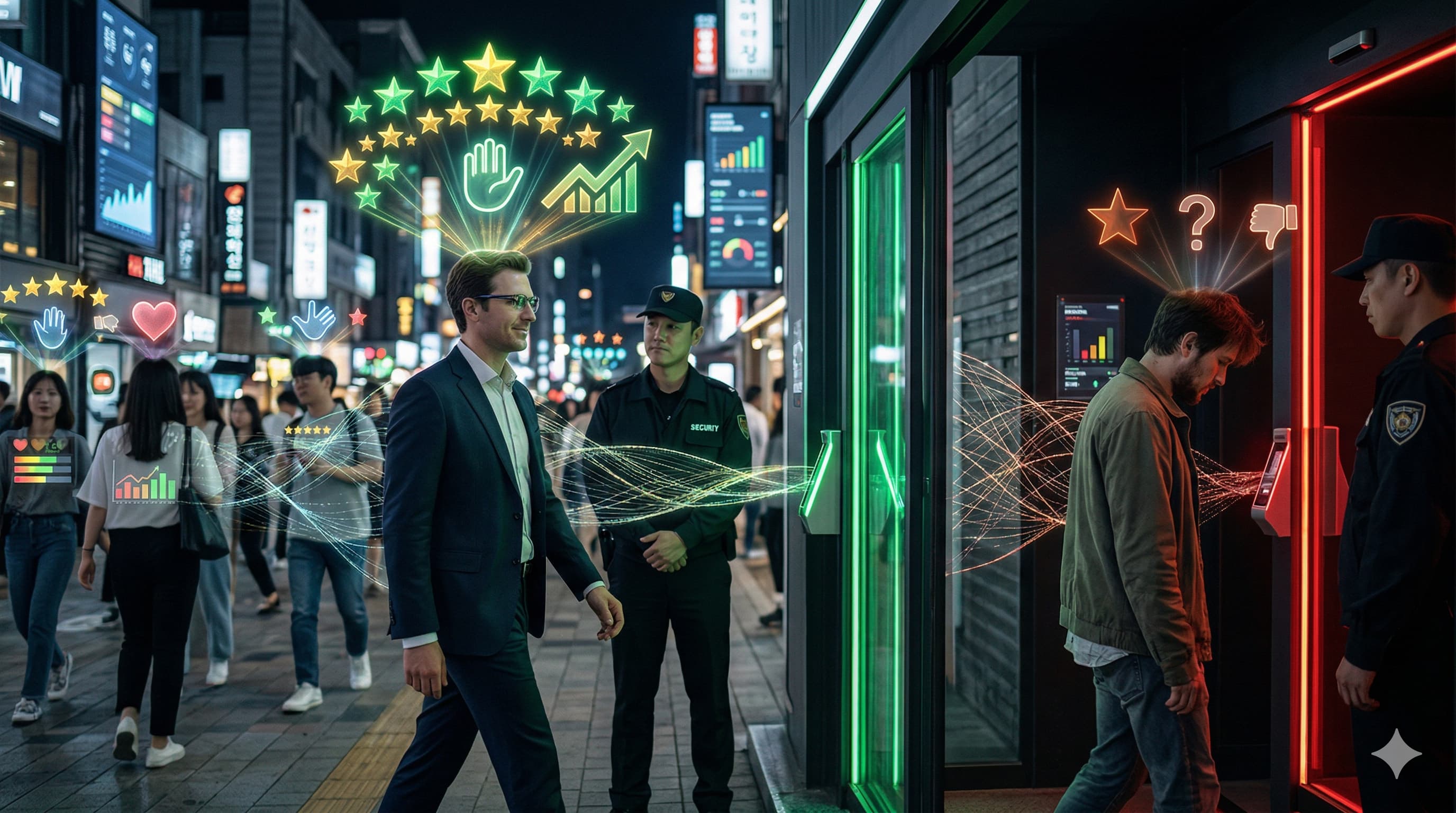
Ratings and evaluations have become an inseparable part of modern life. We rate Uber drivers and restaurants on Google Maps, leave reviews on Amazon and LinkedIn. Our reputations are assembled from numbers, stars, and comments by strangers. The psychology of ratings is the psychology of reputation in its newest, digitized form. And it changes not only markets but human behavior — sometimes for better, sometimes for worse.
The Psychology of Ratings: Why We Want High Scores
The drive for high ratings is not simply vanity. It is rooted in deep psychological mechanisms that formed long before online rating systems existed.
Social Proof (Cialdini)
Robert Cialdini, in his classic "Influence: The Psychology of Persuasion" (1984), described six principles of influence, one of which is social proof. The principle: under conditions of uncertainty, people look to others' behavior as a signal of the right choice. A restaurant with hundreds of positive reviews seems safer than one without reviews — even if the objective quality of food is identical.
Social proof is especially powerful in three situations: when a person is uncertain about their choice, when the situation seems unfamiliar, and when the evaluators resemble them. This is why "similar" reviewers — people with similar tastes, age, lifestyle — are perceived as more credible sources than impersonal average scores.
For business, this means: ratings are not just information, they are a social signal that influences decision-making more strongly than most objective product characteristics. Harvard Business School research showed: a one-star increase in a restaurant's Yelp rating (out of five) correlates with a 5–9% increase in revenue.
Ratings as a Signaling System
In economics, there is signaling theory, developed by Nobel laureate Michael Spence. A signal is an action or characteristic that conveys information about hidden qualities of an agent. Education is a signal of ability. A product warranty is a signal of manufacturer confidence. A rating is a signal of reputation.
The problem with ratings as signals is that, like any signal, they can be distorted or faked. Review inflation, fake accounts, company pressure for "5 stars" — all attempts to generate a false signal. When rating systems stop reflecting real quality, they degrade from an information tool to a manipulation tool.
How Ratings Change Behavior
One of the most interesting aspects of rating systems is their reverse influence on those being rated. Knowing you are being evaluated changes behavior — sometimes predictably, sometimes unexpectedly.
The Uber Effect: Restraint from Fear of Evaluation
When Uber introduced its two-sided rating system — passengers rate drivers, drivers rate passengers — something unexpected happened. Passengers began behaving more politely: arriving on time, not leaving trash, engaging in light conversation. Drivers, in turn, became more attentive.
Researchers called this the "Uber effect": the visibility of evaluation changes behavior toward greater politeness and norm compliance. This is a powerful illustration of how incentive structures change real human behavior. Critically: people behave better not because they became better as people — but because system incentives made good behavior advantageous.
This is the key distinction: reputation systems can change behavior without changing character. A person who is polite with an Uber driver only because they fear a low rating — and not polite in unobserved situations — has not become more polite. They have simply learned to perform the system's requirements where it benefits them.
The Hawthorne Effect Online
In the 1920s, famous experiments at the Western Electric plant in Hawthorne, Illinois showed: when workers know they are being observed, productivity increases — regardless of other conditions. This became known as the "Hawthorne effect."
In the age of digital ratings, the Hawthorne effect has become universal. We are constantly in a situation of potential observation: our actions may be rated, photographed, published. This changes behavior in public spaces — sometimes for better (people are more careful, more polite), sometimes for worse (performativity, fear of judgment, constant anxiety about "correct" self-presentation).
Psychologically, the constant sense of being watched is exhausting. Stress research shows: chronic self-monitoring consumes cognitive resources and leads to decision fatigue. If a person constantly thinks "how does this look," they have fewer resources to think "what is the right thing to do."
Social Ratings: Risks and Ethics
Taken to its logical extreme, a rating system becomes a social credit score: a comprehensive evaluation of a person's "value" that affects their access to resources and opportunities.
The Social Credit System: Warning or Dystopia?
China's social credit system, frequently cited in discussions about the future of reputation systems, is in reality far more complex and heterogeneous than Western interpretations suggest. As of the early 2020s, it is more a collection of disparate regional programs than a single comprehensive system. Nevertheless, the principle — automatic reduction of resource access (loans, airline tickets, schools for children) based on behavior evaluation — is real.
Critics point to obvious risks: who determines what "good" behavior is? Who controls the system? How do you contest an erroneous evaluation? Cathy O'Neil, in "Weapons of Math Destruction" (2016), described the broader problem: algorithmic evaluation systems, ostensibly objective, actually encode the biases of their creators and reproduce existing inequalities.
Reputation Bubbles
Another risk — reputation bubbles: systems in which a high rating leads to more interactions, which yield more high ratings — and so on in an upward spiral. This works in reverse too: a low rating limits opportunities, which leads to further rating decline. Psychologically, this relates to labeling theory: when a system assigns a person the label of "bad seller" or "unreliable driver," they begin acting according to that label — sometimes because they lose motivation, sometimes because the system closes better opportunities to them.
Karma vs Reputation: What Is the Difference
Reputation = Others' Opinion; Karma = Real Actions
Reputation is how others perceive you. It depends on communication, visibility, context, and luck. A good person can have a bad reputation due to misunderstanding. A bad person can have an excellent reputation through skillful impression management.
Karma — in the sense used by karm.top — is a pattern of real actions. It does not depend on whether you are seen or not, evaluated or not. A person who helps a stranger in an alley without witnesses receives no reputational bonuses — but makes a real karmic choice.
This fundamental distinction has practical consequences. When we build behavior only for reputation, we become hostages to the rating system: behaving well where we are seen, and allowing ourselves more where we are not. When we build behavior based on karma — from understanding the real consequences of our actions — behavior becomes more consistent and more authentic. Read more in our article on anonymity and morality.
How to Build Reputation Through Action
The most durable reputation is built not through impression management but through consistent real actions. Several principles for a conscious approach to reputation:
- Primacy of action. Good behavior should precede good reputation, not follow from its goal. Being kind because you want to appear kind is different from being kind because it is right.
- Consistency. Reputation is built on repeating patterns, not one-time actions. One grand gesture does not compensate for systematic disregard for others.
- Honesty about your limitations. The reputation of someone who acknowledges mistakes and works on them is more durable than the reputation of someone who never makes mistakes (because they hide them).
- Separation of contexts. Professional reputation, reputation among friends, family reputation — different systems that need not align. Attempting to maintain a single "brand" across all contexts leads to performativity.
- Long-term thinking. Reputations are built over years and destroyed in an instant. Understanding this asymmetry changes the planning horizon.
Read more about professional reputation in our article on karma at work. About digital reputation and online behavior — in the article on digital karma.
karm.top Ratings: A Different Coordinate System
The karm.top leaderboard works differently from most rating systems. It shows not "best" and "worst" in an absolute sense, but karmic profiles — patterns of real behavior in different life situations. This is not a competition for position, but a map of who you are.
Visit the leaderboard — not to take first place, but to understand how you compare with others in different behavioral categories. This is a more honest and more useful form of social comparison than most existing rating systems.
Frequently Asked Questions
What is social proof in the context of ratings?
A principle described by Robert Cialdini: under conditions of uncertainty, people orient to others' behavior and evaluations. Ratings work precisely as social proof: high scores signal that a product or person deserves trust.
What is the difference between reputation and karma?
Reputation is how others perceive you. Karma is a pattern of your real actions, regardless of observers. You can have good reputation and bad karma (by skillfully managing impressions). You can have bad reputation and good karma (by doing the right thing without public recognition).
What is the "Uber effect"?
The phenomenon in which knowledge of mutual evaluation changes people's behavior toward greater politeness and norm compliance. Discovered through analysis of participant behavior on platforms with two-sided rating systems (Uber, Airbnb, etc.).
What makes algorithmic reputation systems dangerous?
They appear objective but encode the biases of their creators and reproduce structural inequalities. As Cathy O'Neil warned in "Weapons of Math Destruction": evaluation systems built on historical data discriminate against those who historically had less access to opportunities.
Digital Footprint as the Modern Form of Karmic Record
In the digital age, our reputation is formed not only through personal encounters but through what we publish, like, comment on, and share. The digital footprint is the modern form of karmic record: it captures our choices and makes them visible to others.
The important question: does your digital footprint reflect your real values? Do you publish what you genuinely believe, or what will get the most likes? Do you comment the way you behave in real life, or does anonymity give you permission for behavior you wouldn't allow yourself in person?
Research shows: the gap between the "online self" and the "real self" is one of the main sources of psychological discomfort in the digital age. Closing this gap — that is, bringing digital behavior closer to real values — reduces anxiety and increases the sense of wholeness. This is work on digital karma. Read more in our article on digital karma.
Reputation and Karma: A Practical Synthesis
In an ideal world, reputation and karma coincide: how others see you accurately reflects who you really are. In the real world, there is always a gap between them. The task is to minimize this gap: behave just as well when no one is watching as when everyone is; build your digital reputation through real actions rather than impression management; treat ratings as feedback rather than goals.
When reputation and karma align — that is what is called "integrity of character." This is not moral perfection — it is consistency between what you believe and how you act. There is one simple test: do you behave the same way when being evaluated and when not? If your answer is yes — your reputation and karma are aligned. If no — you know what to work on. Check your karmic profile on the karm.top leaderboard and see where you stand.
Subscribe to new content
We publish articles about karma, self-discovery and spiritual practices. No spam — only the good stuff.
We never share your email with third parties. Unsubscribe anytime.