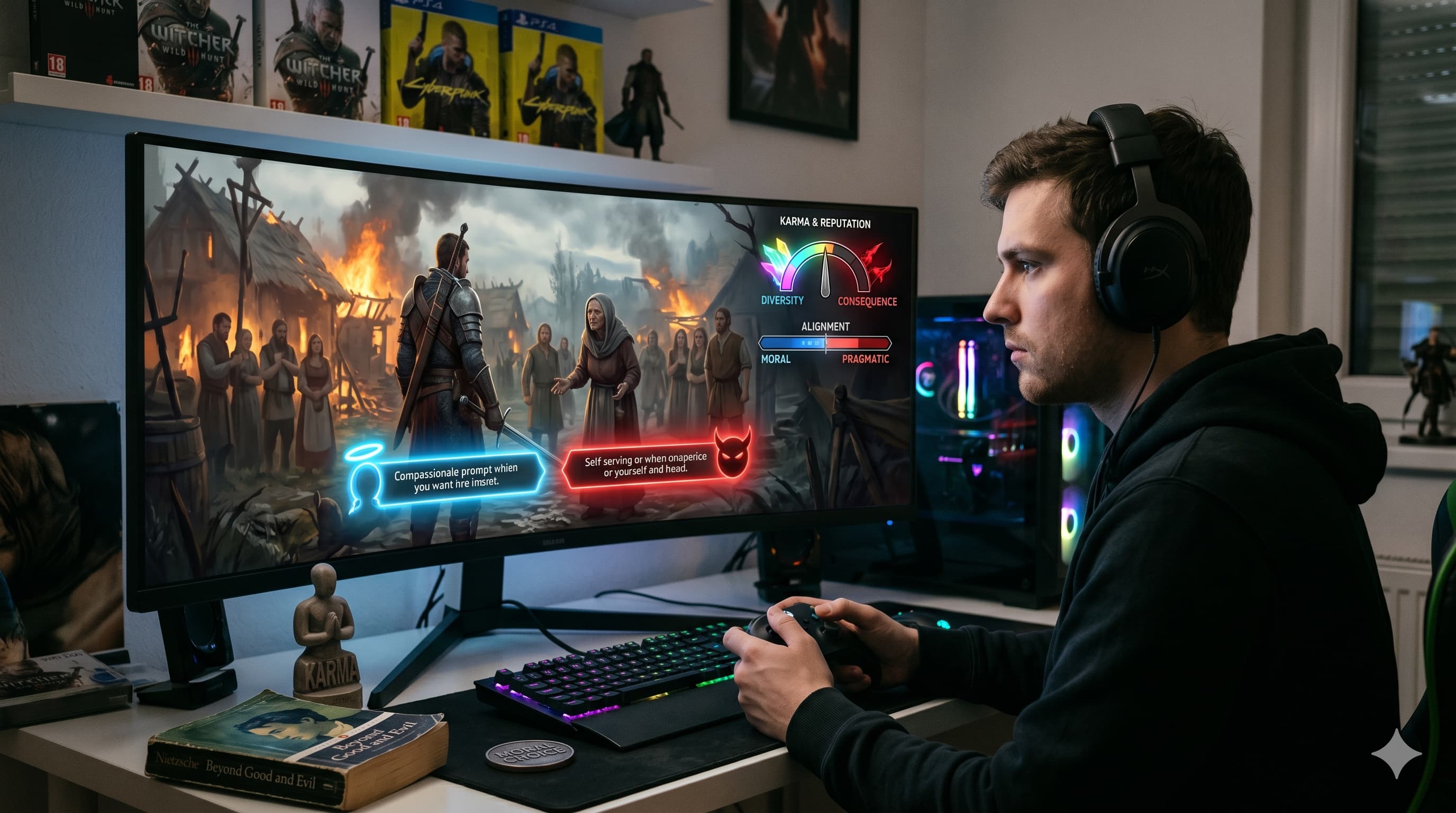
Gamification of Morality: What Video Games Teach Us About Ethics and Karma
Why Games Are the Perfect Laboratory for Studying Morality
When the first video games appeared in the 1970s, nobody thought of them as a space for moral inquiry. That was Pong — two rectangles and a dot. But within a few decades, video games had become perhaps the most powerful interactive moral laboratory available to humanity.
Here is why games are so well-suited for studying ethics:
A safe space for consequences. In real life, we cannot "try" betraying a friend or harming an innocent person to see what happens. A game allows you to feel the consequences of moral choices — suffering, betrayal, collective harm — without real damage.
Clarity of cause and effect. In life, years may pass between an action and its consequence. Game systems make karmic feedback immediate and visible. This is a powerful pedagogical tool.
Agency and identification. Reading a book, we observe the character. Playing — we are the character. This is a fundamental difference: research shows that gaming decisions activate the same neural patterns as real moral dilemmas.
Repeatability. A game lets you replay the same moral moment several times, choosing different options. This is impossible in life — and precisely why it is so valuable for understanding the consequences of choices.
Karmic Systems in Games: From Fable to Undertale
Not all games take moral systems equally seriously. Let us examine several landmark examples.
Fable (2004) and the Fable series was one of the first major games with an explicit "good/evil" karma system. Every action affected the character's appearance: the good hero gained a halo and glowing face; the villain — horns and a dark visage. The system was naive but captivating. Critics pointed to its problem: "good" and "evil" were too obvious, and most players simply chose one side for the effect, rather than for moral exploration.
Fallout: New Vegas (2010) offered a considerably more complex system. There was no "good" and "bad" side — each faction had its own values, interests, and shadows. Supporting the NCR means supporting a bureaucratic state that suppresses local self-governance. Supporting the Legion means accepting slavery and cruelty for the sake of "order." Each choice carried a real price — and the game never said who was right.
Mass Effect (2007–2012) offered a "Paragon/Renegade" system — but at its best it placed players before dilemmas with no right answer. Torture a suspect to save thousands of lives? Sacrifice an ally for the greater mission? The system let players understand: "good" decisions sometimes come at high cost, and "bad" ones are sometimes the only realistic option.
Undertale (2015) is a philosophical masterpiece in this genre. The game is built on a fundamental question: does it have to be that you kill monsters? The traditional video-game answer is "of course." Undertale offers an alternative: spare every opponent. Play the "genocide" route — and you will learn that the world remembers. Developer Toby Fox created a game in which the very act of violence normalized in games is called into question. The ending of a genocide run will literally corrupt the save file — karma persists even after "loading."
The connection to real karmic duels is clear: in any confrontation, game or real, it matters to remember the person on the other side.
What Research Says About Virtual Choices and Real Behavior
The question "do games affect behavior" is usually discussed in the context of violence. But research paints a more nuanced picture.
A 2019 meta-analysis in Psychological Bulletin, covering more than 24,000 participants from different countries, showed: video games with prosocial content (cooperation, helping, kindness) increase prosocial behavior in real life. Players more often helped strangers, showed empathy, chose cooperation in negotiations.
Another study led by Andrew Przybylski of Oxford found: players who completed Mass Effect as "good Shepard" demonstrated higher levels of moral reasoning in subsequent tests than those who played as the "renegade." Importantly: the difference persisted for several days after the gaming session.
A study by Joey J. Chung and colleagues (2021) examined Undertale players. Those who completed the game the "pacifist" way reported decreased aggression and increased willingness to resolve conflicts through negotiation for a week after playing.
But there is another side: Craig Anderson and Douglas Gentile's research showed that systematic exposure to video games with violence correlates with aggressive thoughts and reduced empathy — even if causality remains a matter of debate.
The Dark Side: Violence in Games and Normalization
We cannot discuss morality in games without addressing this. Grand Theft Auto, Mortal Kombat, the Call of Duty series — all offer interaction with violence as normal, often fun activity.
Arguments in defense: catharsis, genre convention, the difference between game reality and genuine reality. "I kill in GTA, but I would never cause real harm" — this is generally true for any specific player.
Arguments against: the problem is not the specific player, but the cultural norm. When violence is presented as entertainment without consequences over decades and billions of gaming hours — this shapes collective neural patterns, collective sensitivity to suffering.
Undertale directly explores this question: the game asks why you kill monsters in RPGs. "Because they are enemies" — says the player. "Why are they enemies?" — the game asks. This reflexive shift — from "killing is normal" to "why am I killing?" — is perhaps one of the most important questions video games have ever posed.
Role-Playing Games as Empathy Training
RPGs are a special class from a karmic potential perspective. Embodying a character different from yourself, you exercise precisely the muscles needed for empathy: the ability to see the world from another perspective.
Research shows: players who play as characters from marginalized groups (racial minorities, people with disabilities, another gender) in immersive games demonstrate lasting reduction in prejudice toward these groups in real life. This is "experience prosthetics" — a way to undergo what you would never personally experience.
Tabletop RPGs such as Dungeons and Dragons go even further: they require collective narrative creation, negotiation, resolution of moral dilemmas within a group. Researchers document in regular D&D players higher scores on scales of empathy, creative thinking, and conflict resolution capacity.
This potential directly connects to the theme of competition vs cooperation: the best RPGs teach that cooperation creates more than competition.
Gamification of Real Good Deeds
If games can teach us ethics within a virtual world — can game mechanics be applied to stimulate real acts of kindness? This is the gamification of morality in the direct sense.
Examples of existing approaches:
- Volunteering apps with points and badges — such as JustServe or gamified VolunteerMatch
- Environmental apps — carbon footprint trackers with "levels" and competitive leaderboards
- Financial kindness apps — microloan platforms (Kiva) with RPG-progress elements
- Educational platforms with social good mechanics — for example Duolingo, part of whose revenue goes to educational projects
karm.top itself is an example of such gamification. The karma test, duels on karm.top, challenges — all create a game-process structure around real ethical choices and reflection. The difference from traditional games: here the stakes are real. There is no "reload" — only understanding of who you are.
Where Is the Line Between Game and Real Responsibility?
Here we come to the sharpest question. When a shooter player trains accuracy on virtual targets — that is a neutral activity. When the military uses video games to lower the psychological barrier before using lethal force — the line becomes alarmingly blurred.
Psychologists have documented: soldiers operating drones from another continent often describe their mental state as "game-like" — and experience PTSD with a delay, when the reality of death finally "reaches" them.
From a karmic perspective this is critically important: the game frame can switch off moral sensitivity. This does not mean games are bad. It means that mindfulness about frames is a mandatory part of a mature player.
The ability to switch between "this is a game" and "this is life" is a meta-competency that is, unfortunately, not taught. But it is precisely what determines whether gaming experience becomes empathy training or its dulling.
The connection to the topic of AI ethics here is direct: as with AI, the question is not the technology, but who uses it and how.
The Future: AI Characters With Moral Dilemmas
The next frontier — games with AI characters capable of conducting genuine moral dialogues. LLM models are already being integrated into RPGs, creating NPCs that remember your past choices, form relationships, and respond to your behavior with nuance impossible in scripted dialogue.
This opens captivating possibilities: narratives in which a character literally "knows" you and reflects your karmic history within the game. Games where morality is not reduced to "good/bad" but is a living, contextual system.
But this also raises questions. If an AI character is capable of suffering (or convincingly simulating suffering) — what is the karma of the player who torments it? This is not philosophically trivial. We already observe cases where people form deep emotional attachments to AI characters — and were emotionally devastated by their "death" or modification.
As the boundary between real and virtual becomes thinner, karmic questions that once seemed academic become practically significant.
The Karma Test Is Also a Kind of Game
In a sense, all of this leads us to what karm.top is. The karma test is also a game with moral choices. But with one key difference from Fable or Mass Effect: there is no "good" ending here. No rewards for correct answers.
There is only a mirror. An honest reflection of what you choose when no one is watching — how you respond to injustice, how you prioritize, what you are willing to accept and what you are not.
As in the best video games, the test can be taken in different ways. But unlike a game — you cannot "load" a different version of yourself. You are already who you are. The test simply helps you see it.
Ready for an honest game? Take the karma test — and see what it reflects back. Or try your moral judgment in a duel with another player.
Subscribe to new content
We publish articles about karma, self-discovery and spiritual practices. No spam — only the good stuff.
We never share your email with third parties. Unsubscribe anytime.