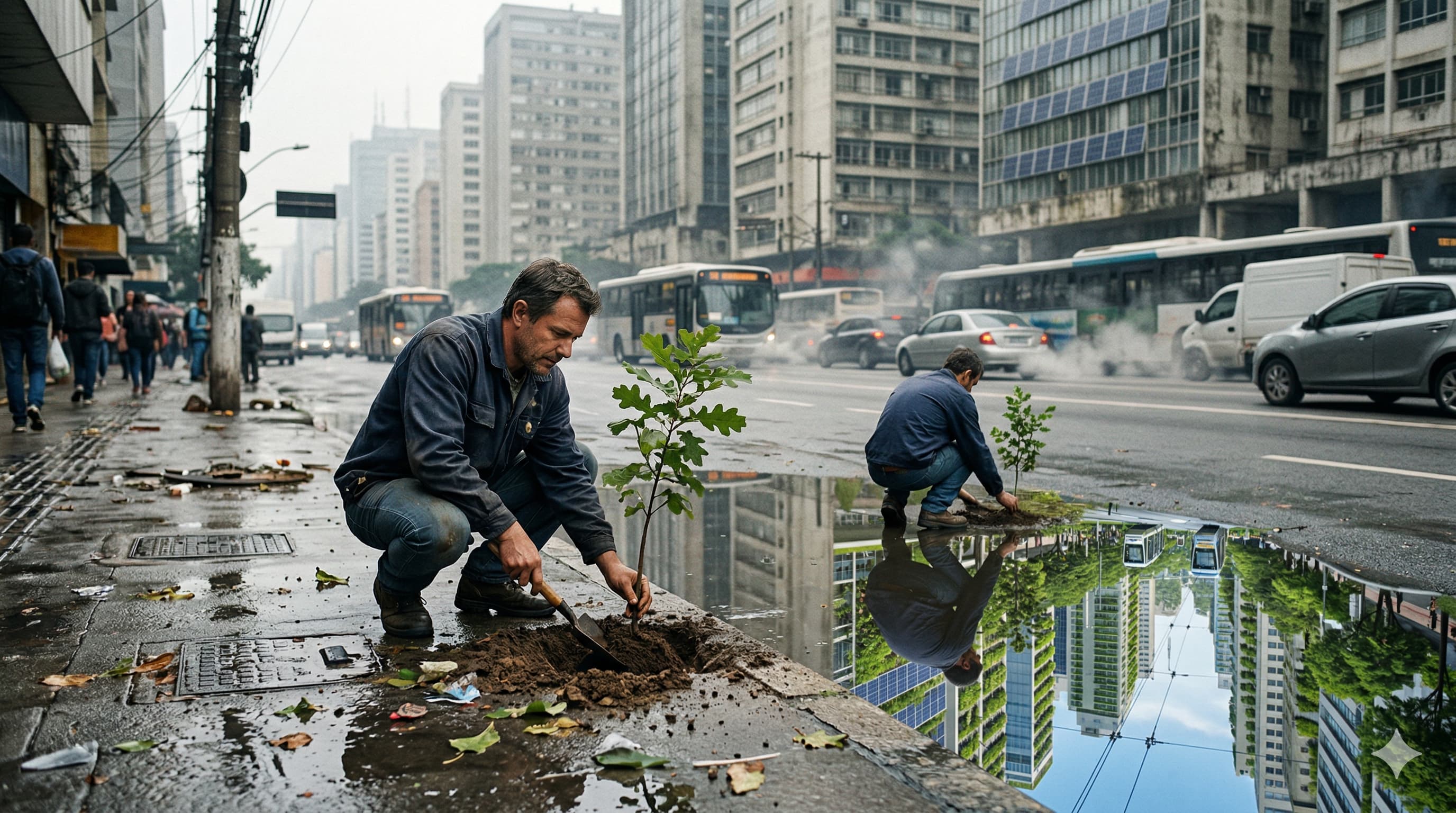
Urban Ecology: The Karma of a City Dweller
The Urban Carbon Footprint: What Goes Into It
Every day you wake up in a city, you automatically plug into a system that generates a massive ecological footprint. Urban ecology isn't an abstract concept for scientists — it's the sum of your specific choices: how you commute to work, what you eat for breakfast, where you toss your coffee cup. According to the UN Environment Programme, cities occupy just 3% of the Earth's land surface, yet consume 75% of global resources and produce approximately 70% of global CO2 emissions. This makes the urban resident a key player in the planet's ecological karma.
The average city dweller in developed countries has a carbon footprint of 6 to 15 metric tons of CO2 equivalent per year. Scientists consider approximately 2 tons per year to be a sustainable target. The gap is enormous — and it demands conscious action.
Data: Urban Residents Produce 70% of Global CO2 Emissions
The C40 Cities Climate Leadership Group, which connects the world's largest cities, conducted a comprehensive analysis of urban emissions. Their data shows: to keep warming within 1.5°C, cities must cut emissions by 50% by 2030. This isn't a number for politicians — it's a number for every resident.
Harvard T.H. Chan School of Public Health has published research showing that urban air pollution — a direct result of transportation and industrial emissions — reduces the average life expectancy of city residents by 1–3 years annually. In other words, your ecological karma directly affects the health of your neighbors, your family, and yourself.
Transportation: The Largest Source of an Urban Dweller's Emissions
A personal car produces an average of 120–200 grams of CO2 per kilometer. For a city dweller traveling 20–30 km daily, that's 2.4–6 tons per year from commuting alone. Air travel adds a significant burden: a round-trip flight from New York to London is equivalent to approximately 0.7 tons of CO2 per passenger.
Home Energy Consumption
Heating, cooling, electrical appliances, and hot water make up the second-largest category of urban emissions. According to the International Energy Agency, buildings produce around 28% of global CO2 emissions. Choosing a renewable energy tariff, insulating your apartment, and switching from incandescent to LED bulbs can reduce your personal carbon footprint by 15–20%.
Food Waste
One third of all food produced in the world is wasted. In cities, this figure is even higher. The production and disposal of food waste generates approximately 8% of global greenhouse gas emissions. Every time you throw away an unfinished yogurt or a wilted salad, you're adding to the atmosphere the carbon spent producing, transporting, and storing it.
Transport, Energy, Waste: Three Key Levers
Three key areas account for the majority of your urban carbon footprint. The good news: in each of these areas you have real levers of influence, and using them doesn't require a radical lifestyle overhaul.
Transport: Public, Bicycle, Walking
Replacing a personal car with public transportation reduces the carbon footprint from travel by 45–70%. A city bus carrying 40 passengers produces 30 times fewer emissions per person than a single car. An electric scooter or bicycle reduces emissions to zero. Even walking one or two stops makes a difference for both the environment and your health.
If giving up a car entirely isn't possible, consider carpooling: sharing rides with neighbors or colleagues cuts emissions in half. According to C40 Cities, just 10% of drivers switching to public transit reduces a city's total transport emissions by 12%.
Energy: Smart Appliances, Efficiency Mode
Appliances on standby consume up to 10% of household electricity. Unplugging them is the simplest measure with no loss of comfort. Installing smart thermostats can reduce heating and cooling costs by 15–25%. Replacing an old refrigerator or washing machine with an A+++ energy-rated model pays for itself in 3–5 years through energy savings.
Waste: Sorting and Reducing
Waste separation is a basic urban practice that many people haven't yet adopted. Recycling one ton of paper saves 17 trees and 26,500 liters of water. Recycling an aluminum can requires 95% less energy than producing a new one. But even more important than recycling is reduction: buy less single-use material, choose products with minimal packaging, bring a reusable bag.
Urban Green Spaces: Benefits and Stewardship
Parks, gardens, and public squares aren't just city decorations. They're functional infrastructure that reduces urban heat island temperatures, absorbs CO2, filters particulate pollution from the air, and lowers noise levels. One mature tree absorbs about 22 kg of CO2 per year and produces enough oxygen for 2 people.
Research on Green Spaces and Mental Health
Harvard T.H. Chan School of Public Health conducted a study covering 108,630 women. Result: those living in areas with more greenery had a 12% lower mortality risk and 34% lower rates of mental health disorders. UK studies showed that visiting green spaces at least once a week reduces the risk of anxiety and depression by 30%.
Your role as a city dweller is not just to use green spaces, but to protect them: participate in public hearings about construction projects, plant trees through city programs, keep parks clean. This is a direct investment in the ecological karma of your neighborhood.
Urban Practices: Small Actions, Big Impact
Changing urban ecological behavior doesn't require sacrifice — it requires awareness. Here are 10 specific actions, each with a measurable effect.
- Skip the elevator for 2–3 floors: reduces personal electricity consumption and improves health.
- Switch to LED lighting: 75% lower energy consumption, lifespan 25 times longer.
- Use a reusable bottle and travel mug: saves up to 500 disposable cups per year.
- Buy from local producers: reduces "food miles" — the distance food travels to reach your plate.
- Sort your waste: start with just separating plastic and paper — that's already a huge step.
- Use public transit at least 2 days per week: annual CO2 savings of approximately 0.5 tons.
- Eat less meat: producing 1 kg of beef generates 27 kg of CO2, 1 kg of chicken 6.9 kg, 1 kg of lentils 0.9 kg.
- Plan your food shopping: a shopping list reduces food waste by 30–40%.
- Grow plants on your balcony or windowsill: a small contribution to urban greening and biodiversity.
- Join local environmental initiatives: cleanups, tree-planting events, waste separation programs.
Each of these actions seems negligible at a planetary scale. But C40 Cities provides data: if just 20% of a large city's residents change their transportation behavior, city transport emissions drop by 25%. Collective karma is built from individual actions.
Ecological Karma: How Your Urban Choices Return to You
The concept of karma in an ecological context isn't mysticism — it's systemic logic. Your actions create the environment in which you yourself live. The air pollution produced by your car is the same air you breathe. The plastic you throw in the general waste bin returns to you in a few years as microplastics in your drinking water and food.
Research published in Environmental Science & Technology found that the average person consumes about 5 grams of microplastics per week — the equivalent of a credit card. Most of this microplastic is the result of our collective attitudes toward waste.
Ecological karma operates in two directions. Destructive patterns — overconsumption, irresponsible waste management, disregarding environmental standards — create an environment that degrades faster than it recovers. Constructive patterns — mindful consumption, participation in urban environmental programs, supporting green spaces — create an environment where quality of life grows.
To understand which patterns dominate your daily life, take the test at karm.top — karma test. The Ecology section includes situations that will help you see how well your daily choices align with your values. Also explore our content on ecology and karma and on the zero waste philosophy.
Frequently Asked Questions
What is a city dweller's carbon footprint?
It's the total volume of greenhouse gas emissions directly or indirectly produced by one person per year. It includes transportation, home heating/cooling, food, consumer goods and services. On average, it amounts to 6–15 tons of CO2 equivalent in developed countries.
What can a city dweller do right now for the environment?
Start with three steps: use public transportation at least a few days per week, begin sorting at least paper and plastic waste, switch to LED lighting. Each of these actions can be implemented without significant time or financial investment.
Is it true that individual actions don't matter at a planetary scale?
This is a common misconception. According to C40 Cities data, a behavior change in even 10–20% of a large city's residents creates a measurable effect on the city's overall emissions. Furthermore, individual actions shape social norms that influence others' behavior.
Subscribe to new content
We publish articles about karma, self-discovery and spiritual practices. No spam — only the good stuff.
We never share your email with third parties. Unsubscribe anytime.