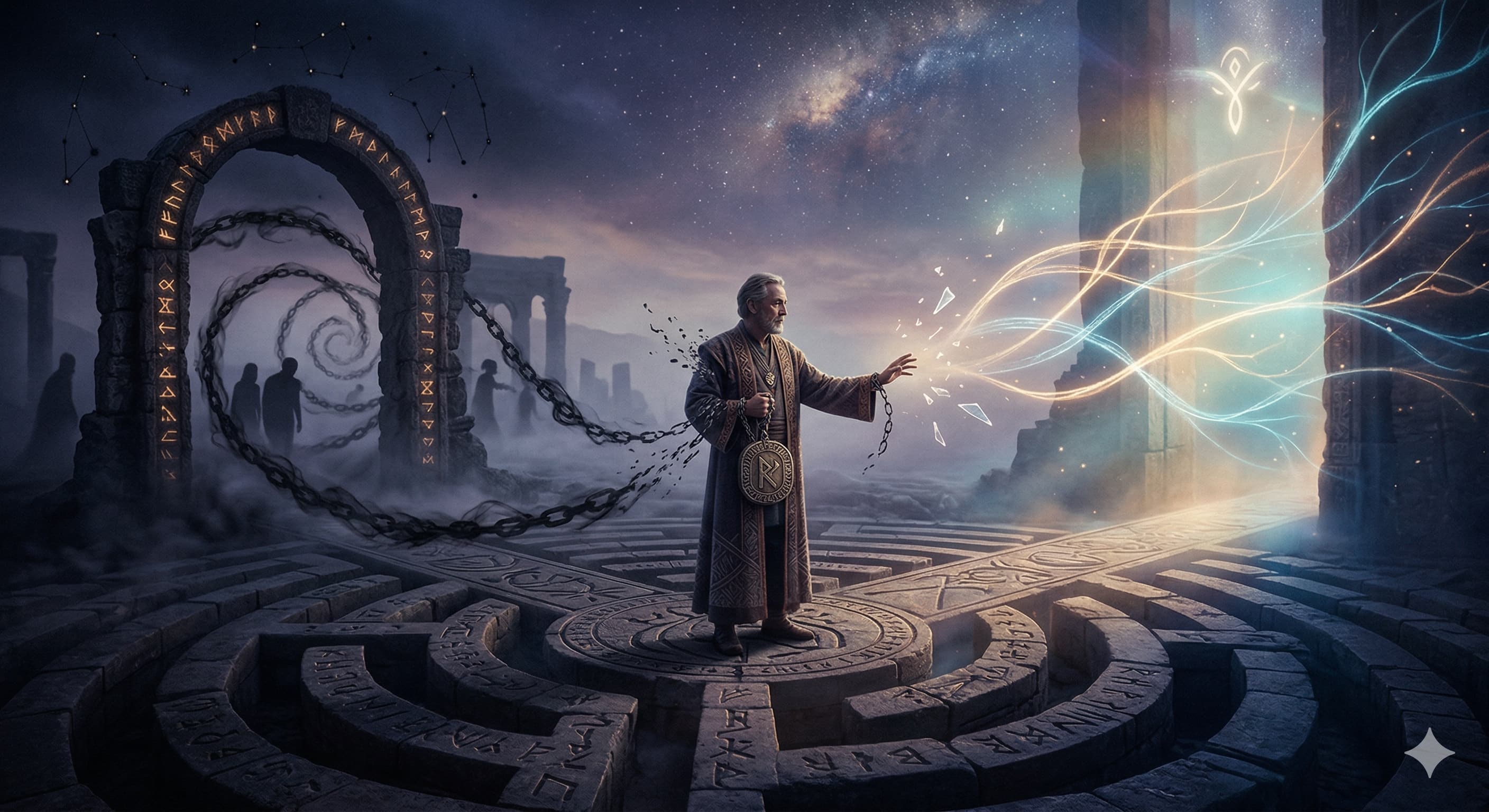
Karma and Free Will: Does the Past Determine Our Future?
One of the most challenging questions posed by the concept of karma is this: if past actions determine the present, and present actions determine the future, where is there room for free will? Does karma become a deterministic trap with no exit?
This question has occupied philosophers for millennia — from the Stoics to Kant, from Buddhist thinkers to modern neuroscientists. And the answer turns out to be surprisingly optimistic. Before diving into the details, read our foundational article on what karma is.
Determinism vs Free Will: The Philosophers' Positions
Determinism holds that every event, including every decision we make, follows necessarily from prior causes. If that is true — free will does not exist. We merely think we are choosing, while in reality our neurons "decide" for us long before the decision becomes conscious.
Free will, by contrast, holds that we are capable of making genuine decisions not entirely determined by the past. Most contemporary philosophers hold a position called "compatibilism": determinism and free will are compatible. Daniel Dennett, one of the leading philosophers of mind, argues in "Freedom Evolves" that free will is not a mystical capacity to violate the laws of physics, but a real capacity to act in accordance with one's values and respond to reasons.
The Stoics on Karma and Will
Stoic philosophy offered an elegant solution millennia ago: dividing reality into what is within our power and what is not. Marcus Aurelius wrote: "Nothing external can harm you unless you allow it." Epictetus, who was born a slave, insisted: external circumstances are not free, but our response to them is always ours. This is remarkably close to karmic logic: karma sets the context, but does not dictate the response.
The Buddhist Concept of Anatta (Non-Self)
Buddhist philosophy offers an even more radical perspective. The concept of anatta ("non-self") holds that there is no permanent self carrying karma through time. Karma is not a burden dragged by the same personality — it is a stream of cause-and-effect relationships that can be broken. The "you" of the past who committed a harmful act and the "you" of the present are not the same being. You are not obliged to be who you were yesterday.
What Modern Neuroscience Says
In 1983, neuroscientist Benjamin Libet conducted an experiment that turned the debate about free will on its head. He asked subjects to flex their wrist at an arbitrary moment while noting when they first felt the urge to move. The result was sensational: brain activity (the "readiness potential") began approximately 350 milliseconds before the person became aware of the desire to move.
Does this mean there is no free will? Some researchers interpreted the results that way. But Libet himself offered a more nuanced interpretation: even if the brain initiates an action before conscious awareness, we retain "veto power" — we can stop the movement already underway. Free will is not the freedom to initiate, but the freedom to restrain.
The Libet Experiment and Its Critics
Later studies showed Libet's experiment had serious methodological limitations. More precise measurements (Schurger et al., 2012) showed the moment of conscious intention is much closer to the beginning of the action than Libet believed. William James, the founder of American psychology and pragmatism, argued in the 19th century that consciousness is a real player in determining behavior — not merely an epiphenomenon.
Brain Plasticity as an Argument for Freedom
The most compelling neuroscientific argument for free will is neuroplasticity. The brain can reorganize itself in response to experience, practice, and intention. Meditation, psychotherapy, learning new skills — all of these literally change neural architecture. This means: we do not merely react to the past — we actively shape our future capacities to respond. This is karma yoga in a modern neuroscientific reading.
Karma as a Tool of Choice, Not a Prison
Here we arrive at a key reframing: karma is not a verdict, it is information. Past behavioral patterns are data about where you tend to react automatically and where you have a conscious choice. Karma reveals zones of automaticity — and precisely in these zones lies the possibility of growth.
Reframing the Past
The narrative we tell about our past is not an objective record of events — it is an active construction. Psychologist Dan McAdams of Northwestern University showed: people who interpret difficult life events as "redemptive" (leading to growth or change) demonstrate significantly higher psychological wellbeing. We have a degree of freedom in interpreting our own karmic pattern.
The Present Moment as the Point of Change
If the past cannot be changed and the future has not yet arrived, the only real point of freedom is the present moment. Buddhist meditation practice is directed precisely at developing moment-to-moment awareness: the capacity to notice automatic reactions before they are enacted. It is in this gap between stimulus and response — of which Viktor Frankl wrote — that real freedom lives. Karma narrows or widens this gap, but never eliminates it entirely.
Check Your Karmic Path
Take the karma test at karm.top — it will help you see in which situational categories you act consciously. To explore your values and orientations more deeply, use the moral compass test. We also recommend our article on the moral compass.
Frequently Asked Questions
If karma is deterministic, why bother trying?
Trying is precisely your free choice. Karma determines patterns but not specific decisions. Every effort to change a pattern itself becomes part of a new karma.
Can people with "heavy karma" change their fate?
Yes. Neuroplasticity and mindfulness practice show that any behavioral pattern can be changed with sufficient persistence. Heavy karma means more work — but not the impossibility of change.
How does Buddhism view free will?
Buddhism does not posit strict determinism. The concept of anatta says there is no permanent self — but there is a stream of consciousness capable of transformation through practice. Meditation is an exercise in expanding the freedom of response.
Subscribe to new content
We publish articles about karma, self-discovery and spiritual practices. No spam — only the good stuff.
We never share your email with third parties. Unsubscribe anytime.