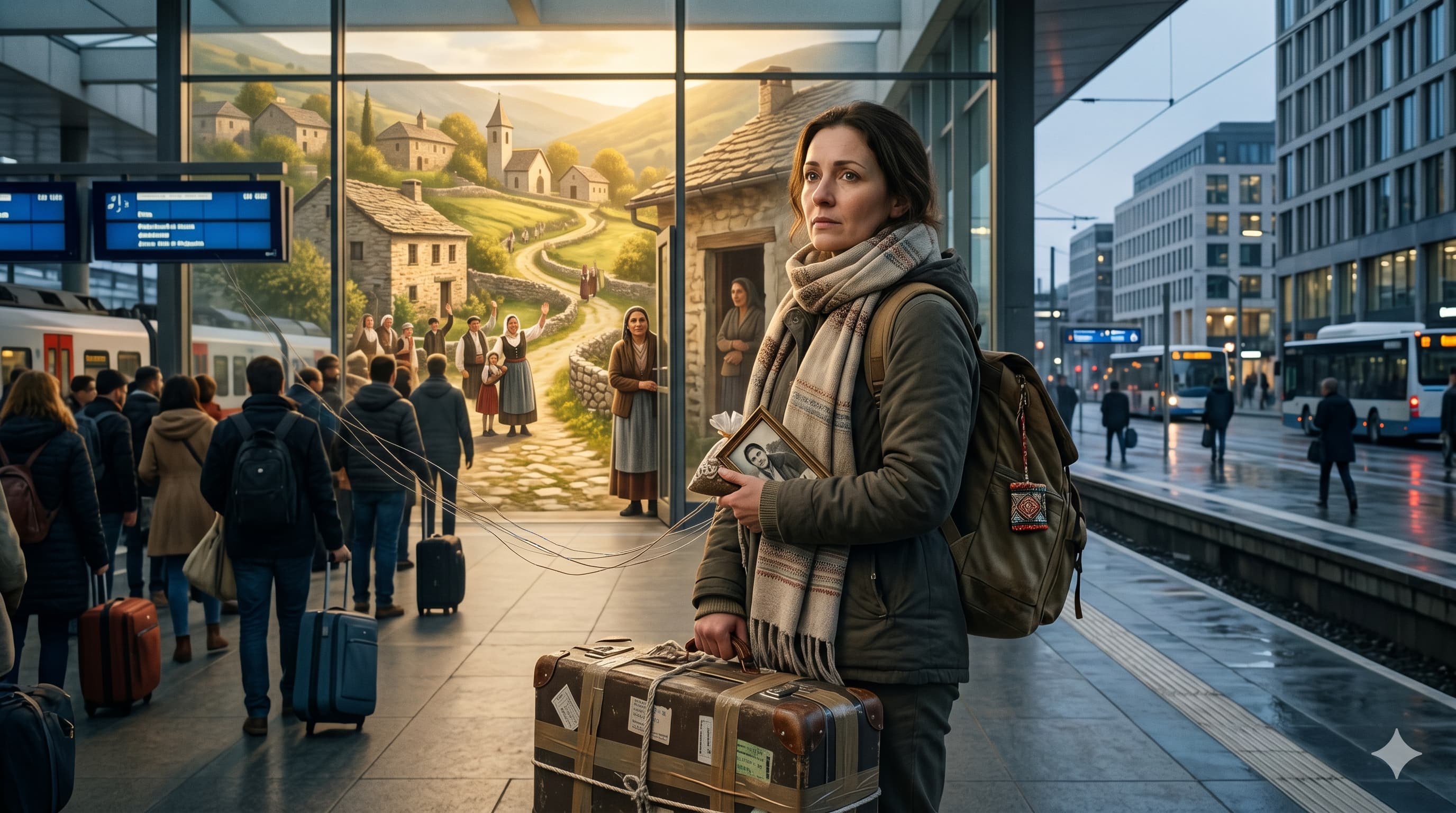
The Karma of Migration: What It Means to Leave Your Homeland
More than 280 million people live in countries other than the ones they were born in. Each of them has experienced the moment of rupture — when the plane lifted above familiar land, when the ferry crossed the border, when their feet stepped onto foreign soil. This rupture leaves a mark that doesn't disappear with a new language, passport, or address.
Migration is one of the most significant karmic events in human life. It severs familiar ties, calls identity into question, and simultaneously opens possibilities unavailable in the previous world. How does the karma of migration work?
Leaving Roots: Karmic Loss and Freedom
Anthropologists describe homeland through the concept of the "cultural matrix" — the system of meanings, values, rituals, and relationships in which a person's character formed. Leaving one's homeland means losing this matrix. Research shows that first-generation migrants experience elevated levels of anxiety, depression, and disorientation for several years after moving — even if they moved voluntarily and into better conditions.
This isn't simply homesickness. It is a profound ontological loss — the loss of a world where you understood what was happening, the loss of a shared body language and meaning, the loss of the relationship network that created a sense of reality. Psychologists call this "cultural grief."
But this loss has a flip side. Deprived of the familiar matrix, a person is compelled to ask: who am I outside it? What in me is genuine, and what was simply absorbed from my environment? This question is one of the most important for spiritual development. Migration can become a catalyst for deep self-knowledge. Take the karma test to understand how your life experience, including migration, shapes your karmic profile.
Nostalgia as a Karmic Signal
Nostalgia — from the Greek words for "homecoming" and "pain" — was long considered a disease. Today we know that nostalgia is a normal human emotion serving important psychological functions. Research by psychologist Constantine Sedikides showed: nostalgia strengthens the sense of continuity of identity, enhances the sense of meaning in life, and social connectedness.
From a karmic perspective, nostalgia is a signal. It points to something important that was present in the past life and is lacking in the present. It doesn't call for going backward — it asks: "What from the past is valuable enough to recreate here, in the new life?" Destructive nostalgia idealizes the past. Constructive nostalgia enters into dialogue with the past, drawing resources for the present.
Integration vs. Assimilation: Keeping Yourself
When a migrant enters a new culture, they face one of the main existential choices: assimilate or integrate. These words are often used as synonyms, but the difference is fundamental.
Assimilation is the abandonment of one's own cultural identity in favor of adopting the culture of the new country. Complete merger.
Integration is the preservation of one's identity while simultaneously adopting the new culture. Adding new without erasing the old.
Decades of research by psychologist John Berry unequivocally show: integration correlates with better mental health indicators, higher self-esteem, and more successful adaptation. Assimilation, especially forced, is associated with anxiety, depression, and loss of identity. Read about how to remain yourself in changing conditions.
Guilt Toward Those Left Behind: How to Live With It
One of the most painful emotions for migrants is guilt toward those who remained. Parents aging without you nearby. Friends going through crisis while you're building a life in another country. This guilt is a normal human reaction. But it can become destructive if left unprocessed.
A psychologically healthy approach includes: recognizing the guilt as normal; taking active steps to support those left behind in accessible forms; separating guilt from responsibility — guilt paralyzes, responsibility motivates concrete action.
Diaspora Karma: Building Bridges
Diaspora consciousness is a unique karmic resource. People living at the intersection of two or more cultures possess a rare gift: the ability to understand different value systems from the inside. This makes them potential bridge builders — translators not just of languages, but of meanings, values, and ways of thinking.
A karmically aware migrant understands: their dual identity is not a problem requiring a solution, but a resource requiring conscious deployment. Read about how different cultures understand karma. Ask the Oracle how your experience of living between cultures might serve a greater purpose.
Reconciling Dual Identity
The migrant's dual identity is not fragmentation — it is richness. But perceiving it this way requires certain psychological work. Here are several practices that help integrate the experience of two worlds.
Name both parts. "I am Ukrainian, living in Germany." "I am Russian who became American." Don't choose between identities — hold both.
Create rituals of both cultures. Celebrate homeland holidays in the new country. Cook dishes from childhood. Read books in your native language. This isn't nostalgic escapism — it's maintaining connection with roots.
Talk to your children. If you have children born in the new country, passing on the culture of their ancestors is a karmically important act. Not coercion — a living introduction to their origins.
Find community. The diaspora community is not a ghetto or isolation. It is a space where you don't need to explain why you miss a certain taste, or why certain stereotypes about your country affect you. Take on the challenge of full dual identity — it is a path of richness, not contradiction.
Migration is one of the bravest karmic steps. It requires courage to meet the unknown. But those who take this step consciously, maintaining connection with the past while opening to the present, often discover that it is precisely at the intersection of two worlds that something unique is born — their particular contribution to the great human story.
Subscribe to new content
We publish articles about karma, self-discovery and spiritual practices. No spam — only the good stuff.
We never share your email with third parties. Unsubscribe anytime.