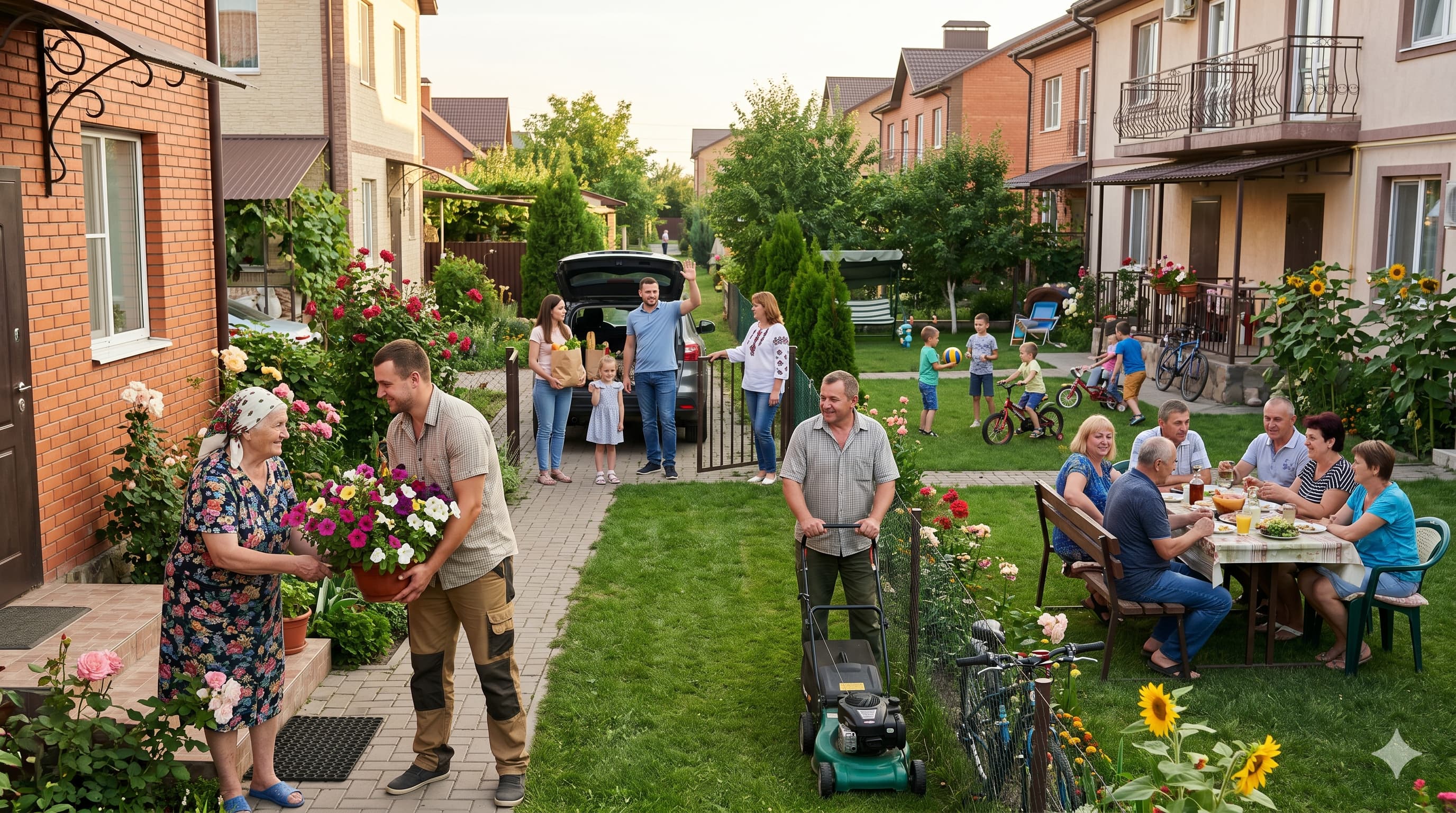
The Karma of Neighborliness: How We Live Alongside Others
Have you ever noticed that you can live years side by side with someone without knowing their name? In the apartment buildings of modern cities, this is the norm: we share walls, ceilings, staircases, elevators — and yet remain strangers. Some find this convenient. But psychologists, sociologists, and wellbeing researchers have documented something important: the quality of neighborly relationships directly affects health, life expectancy, and subjective happiness. Neighborliness is not a domestic question. It's a karmic one.
The Neighbor as a Mirror of Our Attitude to Boundaries
There is no more precise test of personal maturity than how someone behaves with their neighbors. This is exactly where two fundamental impulses intersect: the desire to have personal space and the necessity of coexisting with others in a limited environment.
A neighbor is someone we didn't choose. Unlike friends, partners, or colleagues — a neighbor entered our lives simply because they bought or rented an apartment nearby. This makes neighborly relations a unique laboratory: here it's impossible to "select your audience" or escape conflict through distance. We must learn to live alongside.
How do we handle this challenge? Most often — through one of two extremes. The first: complete isolation, ignoring, the principle of "I don't interfere in their business — they don't interfere in mine." The second: merging without boundaries, where neighbors become a sort of extended family with its advantages and conflicts. Both approaches have their costs.
Psychologist Robert Weiss, who studied loneliness, identified two types: social isolation (absence of a support network) and attachment loneliness (absence of close connection). People who live in isolation from neighbors often experience the first type even when they have an active social life outside the home — because home becomes a "quiet zone without people." And the feeling of safety at home is directly connected to the feeling that there are people nearby who know you.
Discover how your daily choices reflect your values through the karma test.
Neighbor Conflicts: A Karmic Perspective
Statistically, conflicts with neighbors are one of the most common sources of chronic stress for urban dwellers. Noise, parking, pets, smells, garbage — the list of irritants is endless. But behind most of these conflicts lies a deeper dynamic.
A conflict with a neighbor is almost always a conflict about boundaries. Where does my space end and yours begin? Whose needs matter more? Who should yield? And here the karmic work begins: how we answer these questions says a great deal about who we are.
Research by conflict mediators from Harvard's Negotiation Program found that most prolonged neighbor disputes (including expensive lawsuits) began with a small incident to which one party responded with either ignoring or aggression. Neither works. Ignoring allows resentment to accumulate. Aggression triggers reciprocal aggression. The only thing that works is early conversation.
But there's a nuance: the conversation must come from a position of interests, not positions. Not "stop making noise" (a position), but "my child falls asleep at nine, I need quiet after that time — how can we work something out?" (an interest). This simple shift in communication resolves approximately 80% of neighbor conflicts without involving third parties.
Read about how small actions shape large karmic patterns.
The Anonymity of Big Cities and Its Price
German sociologist Georg Simmel described the paradox of the big city as far back as 1903: the more people surround us, the deeper each person's inner isolation. In a village, everyone knows everyone — this is both strength and limitation. In a megacity, no one knows anyone — and this is both freedom and loneliness.
Modern data confirms Simmel. Robert Putnam's research "Bowling Alone" documented a sharp decline in social capital in American cities over the past half-century: neighbors know each other less, communicate less frequently, trust each other less. And this has measurable consequences: in neighborhoods with high social capital, crime rates are lower, residents are healthier, children perform better academically, and recovery from natural disasters is faster.
Anonymity is an illusion of independence. In reality, we are deeply interdependent: we share infrastructure, environment, safety. When an elderly neighbor dies in their apartment and no one knows for weeks — this is not just the tragedy of one individual fate. It's a symptom of collective disconnection. When a neighbor's child goes without eating for days and no one notices — that's a community failure.
Karmically, anonymity means: we're evading relationships that might ask something of us. But evasion isn't free: we also lose what those relationships could give us.
Small Kind Gestures That Change the Atmosphere
The good news: to change the quality of neighborly relations, you don't need to become best friends. Research shows that regular small signals of recognition and goodwill are sufficient.
Nicholas Epley from the University of Chicago conducted a now-famous experiment in the subway: one group of participants was asked to strike up a conversation with a nearby stranger, the other to behave as normal. Participants expected that talking to a stranger would be awkward and unpleasant. In reality — nearly all reported a more pleasant ride than usual. We catastrophically underestimate how much small moments of contact with other people improve our state.
What does this mean for neighborliness? Several concrete gestures that change the atmosphere:
- Greet by name. Learn the names of your nearest neighbors — and use them. "Good morning, Michael" isn't familiarity — it's recognition of a person.
- Offer specific help. Not "let me know if you need anything" but "I'm heading to the store — can I bring you something?" A specific offer is easier to accept.
- Be first with the good. Don't wait for the neighbor to introduce themselves to you — introduce yourself.
- Notice changes. If a neighbor hasn't been seen for a while, if something seems unusual — check in. This isn't intrusiveness — it's care.
- Share small joys. Balcony harvest, homemade pie, flowers from the dacha — this is the ancient language of good-neighborliness, understood without words.
Community vs Individualism: What We Lose
Western culture of recent decades has made individualism its supreme value. To be self-sufficient, independent, not needing others — this is perceived as a sign of strength. But anthropologists, historians, and psychologists are saying increasingly loudly: we have overvalued individualism and paid for it with an epidemic of loneliness.
Researcher Vivek Murthy, former Surgeon General of the United States, called loneliness "the epidemic of our time": more than half of Americans report significant symptoms of loneliness. The health consequences are comparable to smoking 15 cigarettes a day. Chronic loneliness increases the risk of cardiovascular disease, stroke, dementia, and premature death.
Neighborhood community is one of the most accessible antidotes. Not because you need to be close friends with neighbors (that's optional), but because the feeling that there are people living around you who know you and who care — this is a basic form of social safety. This is what scientists call "weak ties" — they are statistically more important for happiness and health than we tend to think.
Read about how small acts shape large consequences.
Practice: Three Steps to Better Neighborly Relations
A concrete plan for the coming week:
Step 1: Introduce yourself. If you don't know the names of your nearest neighbors — meet them. Simply: "Hi, I live in apartment 47, my name is Anna." This is enough for a start. No need to invite anyone to dinner — knowing a name and saying hello is sufficient.
Step 2: Create one positive experience. Do something specific and small: give advance notice of expected noise, hold the elevator, help carry groceries, take out the shared trash without waiting to be asked. A small gesture creates the first thread of reciprocity.
Step 3: Resolve one open issue. If there's an unresolved matter between you and a neighbor — summon the courage to raise it. Not through a note, not through the building management — in person. Begin from a position of goodwill: "I want to find a solution that works well for both of us." This conversation may be uncomfortable. But karmically, it's necessary.
Neighborliness is a micro-model of society. How we treat the people we didn't choose but live alongside — this is who we are. The karma of neighborliness returns through the quality of our everyday life: through the feeling of safety, through the small joys of shared existence, through knowing that there are people nearby who care about you. Explore your values more deeply through the karma of urban ecology.
Subscribe to new content
We publish articles about karma, self-discovery and spiritual practices. No spam — only the good stuff.
We never share your email with third parties. Unsubscribe anytime.