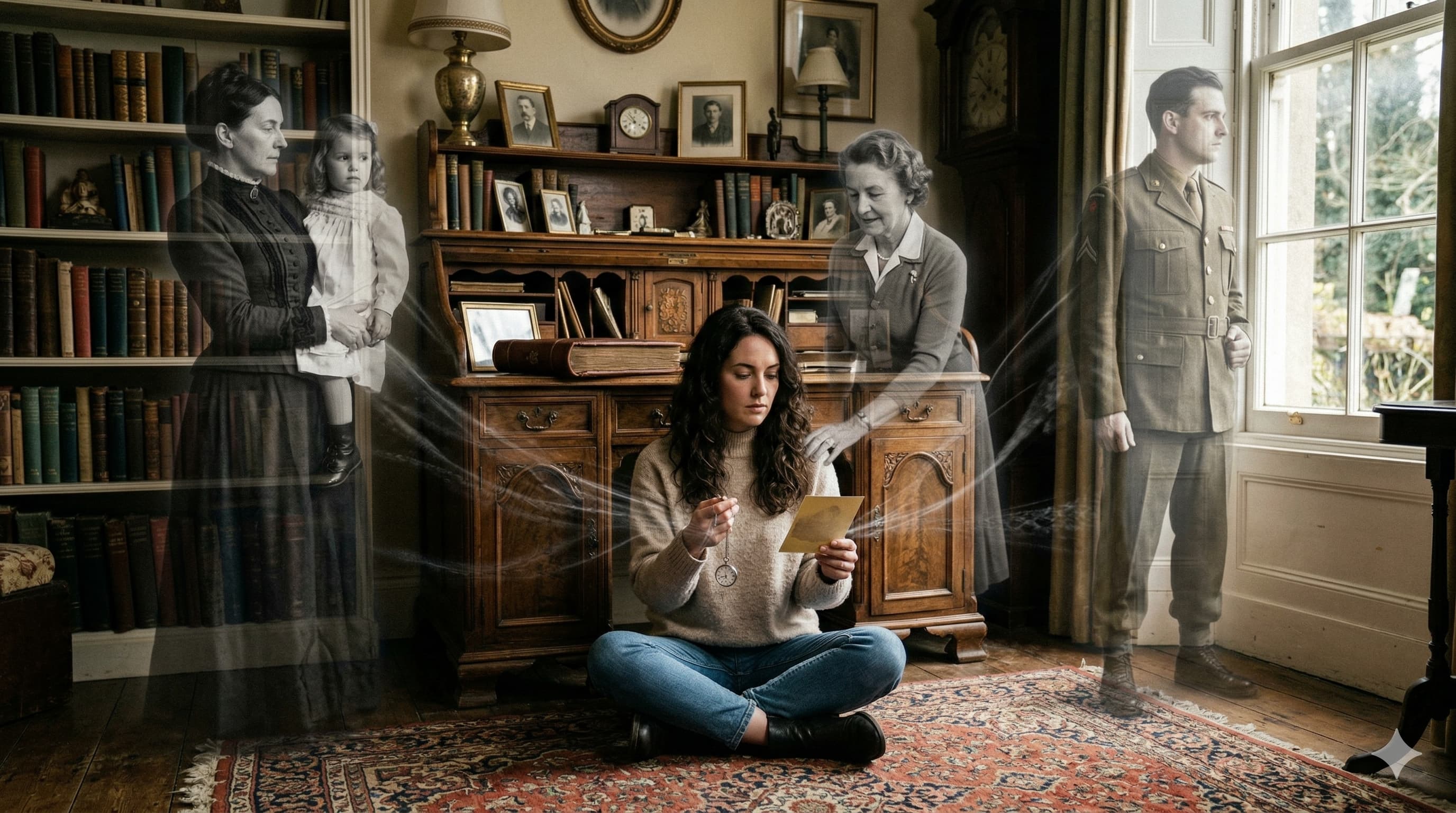
Family Karma: How Ancestral Patterns Influence Us
What Is Transgenerational Transmission
Family karma is a concept describing how behavioral patterns, emotional responses, beliefs, and even life scripts are passed from generation to generation. This is not mysticism — it is a well-documented psychological phenomenon that scientists call transgenerational transmission.
Ivan Böszörményi-Nagy, a Hungarian-American psychiatrist, developed the concept of "contextual therapy," in which he described how "relational ethics" — a sense of duty, loyalty, and unclosed accounts — is transmitted between generations. In his observations, children literally carry the unclosed "debts" of their ancestors without realizing it.
French psychoanalyst Nicolas Abraham introduced the concept of the "phantom" — a psychic trace of an ancestor's unresolved tragedy or secret, transmitted to descendants and influencing their behavior even though they don't know its source.
Modern epigenetics adds a biological dimension: research, including work by Michael Meaney's group at McGill University, shows that traumatic experience can alter gene expression, affecting descendants' stress responses. This means family karma is not only psychology but partly biology as well.
Recurring Family Scenarios
Looking at several generations of one family, one often finds remarkable coincidences: the same age for a first major crisis, similar relationship patterns, the same financial mistakes or professional trajectories. This is family scripts in action.
Financial Patterns
Attitudes toward money are among the most persistently transmitted family programs. If a grandfather survived famine or economic crisis and internalized the belief "money will always run out," this belief — often unconsciously — is transmitted to children and grandchildren. They may fear investing, spending, or conversely, compensatorily spend everything available.
Psychologist Susan Forward in "Toxic Parents" details how financial patterns are established in childhood through observation and direct messages such as "we can't afford that — we're poor people."
Emotional Patterns
The ability to express and regulate emotions is significantly formed within the family. If sadness was "forbidden" in the family — children develop alexithymia (difficulty recognizing and expressing feelings). If anger was the norm of communication — adult children from such families often reproduce the same patterns in their own relationships.
Psychologist John Bowlby, creator of attachment theory, showed: the attachment style formed in relationships with the first significant adults becomes the "working model" for all subsequent relationships. Anxious, avoidant, or disorganized attachment is transmitted from generation to generation — without conscious intervention.
Relationship Patterns
"All men are like that," "women can't be trusted," "in marriage you have to endure" — these beliefs, heard in childhood, become self-fulfilling prophecies. We unconsciously choose partners who confirm the family narrative. Learn more about toxic relationships and their signs.
How to Break the Cycle
The good news: family patterns are not a sentence. Awareness is the first and most important step toward transformation. Once you see the pattern — you are no longer completely captured by it. A choice appears.
Psychologist Murray Bowen developed the concept of "self-differentiation" — the ability to maintain one's individuality and mature thinking within the family system, without merging with it or cutting off from it. According to Bowen, the higher the level of differentiation — the less a person automatically reproduces family patterns.
Systemic family therapy, in particular the constellation method by Bert Hellinger, helps identify hidden dynamics of the family system. Regardless of one's relationship to the metaphysical component of these methods, their psychological effect — awareness of hidden loyalties — is well documented.
Practical Steps
1. Create a family pattern map. Take three or four generations and record: what events repeated? What beliefs were transmitted? What topics were taboo? This is not about finding culprits — it is about researching the system.
2. Identify the beliefs you inherited. Complete these phrases: "Money is...", "Men are...", "Women are...", "In relationships you must...", "I don't have the right to...". Where do these beliefs come from? Are they yours or did they come from your family?
3. Separate loyalty from repetition. You can love and respect your family without reproducing its destructive patterns. Breaking a family cycle is not a betrayal of ancestors. It is a gift to future generations.
4. Work with a professional. Systemic therapy, psychoanalysis, or attachment therapy provide a container for safe exploration and transformation of these patterns.
5. Practice conscious parenting. Learn about the psychology of altruism and care that underlies healthy family relationships.
Take the karma test to see which family situations most resonate with your experience. Also explore the foundational concept of what karma is.
Frequently Asked Questions
Are family patterns always negative?
No. Families also transmit positive patterns: resilience, work ethic, generosity, the value of education. Working with family karma is about consciously choosing what to keep and what to transform.
What if parents don't want to talk about the past?
Secrets and silenced topics are often the source of the strongest "phantoms." If direct conversation is impossible, use other sources: archives, stories from other relatives, old letters and documents. Even partial reconstruction of the picture can be therapeutically valuable.
Is family karma fatal?
Absolutely not. The word "karma" itself means action, not verdict. Family karma is accumulated experience that requires awareness and transformative action. Each of us can become a breaking point in a destructive cycle — and this may be the most important thing we can do for our family.
Subscribe to new content
We publish articles about karma, self-discovery and spiritual practices. No spam — only the good stuff.
We never share your email with third parties. Unsubscribe anytime.