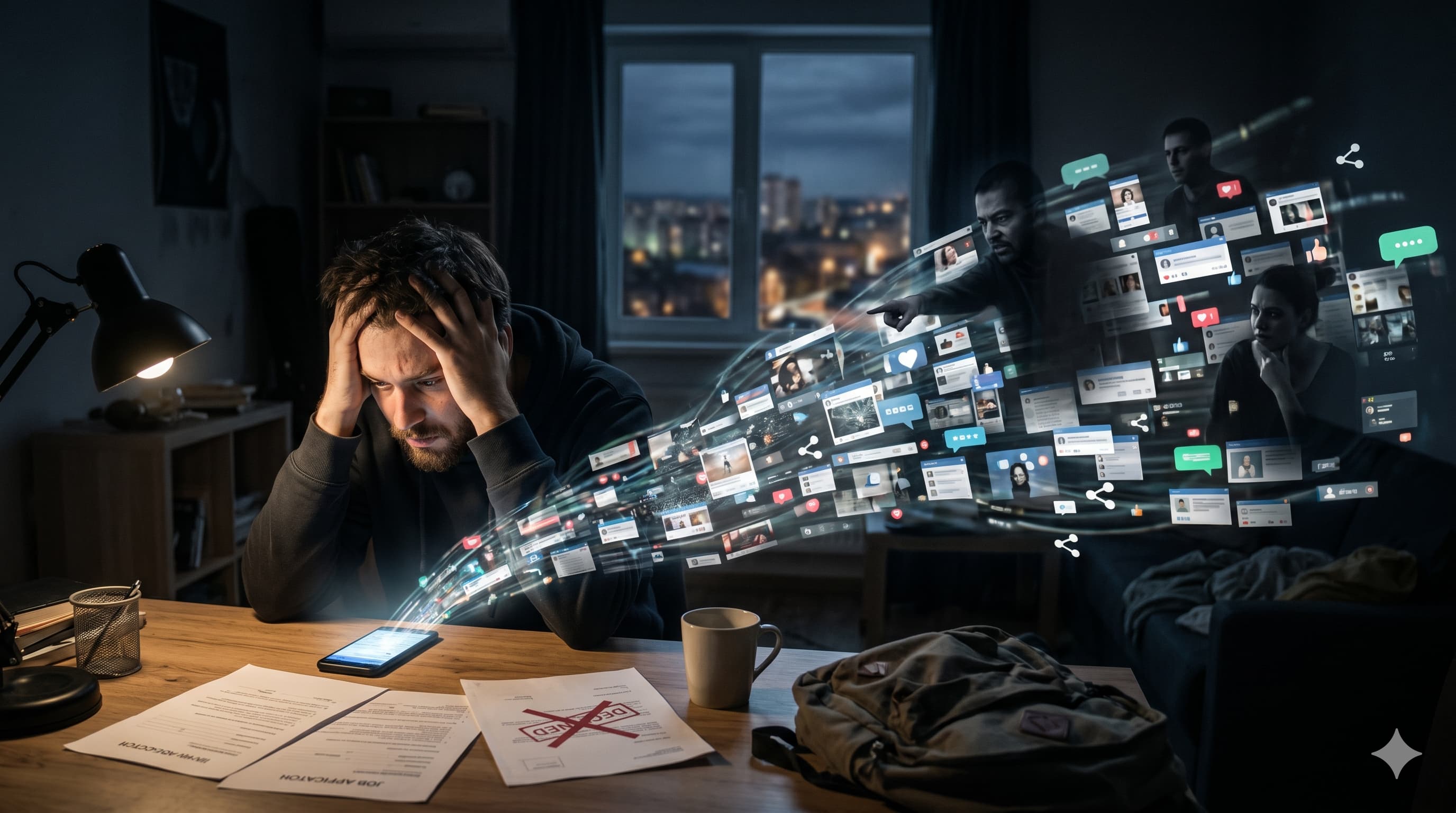
Social Media Karma: Your Online Footprint and Its Real-World Consequences
Why Online Behavior Is Real Karma, Not a Game
Many people behave online in ways they would never act in person. They insult strangers. Share rumors they haven't verified. Mock other people's pain. Stoke conflicts for "lulz." And they genuinely believe this isn't "real" — because it's "just the internet."
But the internet has long ceased to be a parallel reality. It is simply another medium in which real interactions occur between real people with real consequences. Words written online cause the same pain as words spoken in person. Sometimes more — because they're recorded, shareable, and can haunt a person for years.
The karmic logic here is exactly the same as in offline life: every action is a seed that germinates. The difference is only in scale and speed. Online karma spreads faster, wider, and often leaves longer-lasting traces.
An important nuance: anonymity doesn't cancel karma. Some people believe an anonymous account frees them from responsibility — after all, "no one knows it's me." But karmic consequences are experienced not by the account but by the person behind it. Someone who regularly pours hostility online becomes a hostile person — regardless of whether others know it. Read more about the psychology of anonymity in the piece on anonymity and morality.
Hate and Trolling: The Karmic Consequences of Anonymous Aggression
The phenomenon of online hate is one of the most vivid examples of karmic blindness. A person leaving a cruel comment under a stranger's photo typically doesn't think about consequences. They see only a screen, not the living person on the other side.
But research on cyberbullying consequences is merciless: online harassment leads to severe depression, anxiety disorders, and in extreme cases — suicide. Every person who "just joked" in a hate campaign against a specific individual bears a real share of responsibility for real harm.
The psychology of the troll is well understood. At its root lies a combination: a sense of anonymity, deindividuation ("I'm part of a crowd, not a separate person"), and dissociation ("this isn't a real person, just an object online"). All of these mechanisms are forms of self-deception that allow actions from which the person themselves suffers long-term.
The karmic consequences of constant hating: erosion of empathy, growing cynicism, inability to build genuine connections. The troll who thinks they're harming others is actually slowly destroying themselves.
Influencers and the Karmic Responsibility of Public Reach
With great power comes great responsibility — this is a karmic principle that has found a new dimension in the age of social media. A person with a million followers bears karmic responsibility incomparable to that of an ordinary user.
Every post advertising a product that doesn't match its claimed qualities is a lie multiplied by a million. Every statement normalizing discrimination or violence is poison injected into millions of minds. Every photo creating unrealistic standards of body and lifestyle contributes to the epidemic of anxiety and depression we observe in younger generations.
But the reverse is also true. An influencer who honestly shares their failures dismantles a culture of perfectionism. One who openly discusses mental health removes stigma. One who uses their platform to raise funds for real needs converts likes into real benefit.
One of the sharpest influencer karma questions is undisclosed advertising. When a person with an audience recommends a product for money without revealing this, they betray the trust of their audience. This isn't just a legal violation. It is a karmic betrayal of people who trusted them as an authentic voice.
Virality: Fame and Destruction Through a Few Clicks
The age of virality created a new type of karmic harm — swift, massive, and often irreversible. One tweet, one video, one screenshot — and a person's life can turn upside down within hours.
The classic example is so-called "Twitter career catastrophes": someone writes something unfortunate, boards a plane, and lands as a celebrity who has become an object of hatred for millions. Often the victims of viral hatred have made real mistakes — but the scale of retribution is disproportionate to the transgression.
The karmic responsibility question: before reposting something "funny" or "outrageous," it's worth asking: is my repost adding to a wave of harassment or to a wave of good? Will I be ashamed of this repost in a year?
Questions of fakes and disinformation are directly connected to karmic responsibility for what we spread.
Digital Envy: How Social Media Distorts Our Perception of Others' Lives
Social media has created a phenomenon: constant comparison of our real life with the edited highlights of others' lives. People post their best moments, beautiful sunsets, happy relationships, professional successes. Nobody posts a boring Tuesday, arguments with their partner, or professional failures.
Research is unambiguous: passive social media consumption correlates with elevated levels of anxiety, depression, and lowered self-esteem. Fear of missing out (FOMO) is not just a marketing term — it's a real psychological phenomenon that social media actively cultivates.
The karmic aspect is double. First, what you consume: if you consciously use social media in ways that amplify your envy and dissatisfaction, that's your choice — and your karmic consequences. Second, what you broadcast: if your content creates unrealistic expectations in others, you bear some responsibility for their suffering.
The antidote: mindfulness in consumption. And honesty in broadcasting — showing not just successes but also difficulties. This isn't only karmically healthier, but paradoxically also attracts more audience — because people are drawn to authenticity.
Cancel Culture: Just Accountability or Digital Lynch Mob?
Cancel culture is one of the most contentious phenomena of the digital age from a karmic justice standpoint.
The argument for: historically, the powerful had the ability to commit wrongs and escape consequences. Social media gave voice to those who previously couldn't be heard. "Cancellation" is the democratization of accountability.
The argument against: cancel culture often operates without basic principles of justice — the right to defense, proportionality of punishment, the possibility of redemption. A person who made a mistake fifteen years ago in a different context can be "cancelled" today — without accounting for who they've become since.
The karmic truth likely lies in a complex balance: genuine accountability for real harm is necessary. But collective online harassment masquerading as justice is itself a form of harm. The difference between "demanding accountability" and "bullying" is often defined by the intentions of participants: do they want the person to change — or do they want them to suffer?
Questions of online reputation and its long-term consequences are explored further in the piece on ratings and reputation.
Algorithms as a Mirror of Your Karma: What You Consume, You Attract
There is a beautiful metaphor: social media algorithms are a mirror of your attention. They show you more of what you look at and react to. If you regularly engage with content that triggers anger, anxiety, envy — the algorithm will serve you more of that content. If you engage with inspiring, useful, positive content — your feed will gradually change.
In some sense, this is a digital demonstration of the karmic principle that like attracts like. What you give attention to grows. Online algorithms simply make this visible in real time.
The practical consequence: conscious management of your online consumption isn't just psychological hygiene — it's karmic practice. Read the article on digital karma for deeper exploration of this theme.
Building a Positive Online Footprint: Practical Steps
A positive online footprint isn't about constant smiling and avoiding conflict. It's about mindfulness: knowing what you're doing online and why, and taking responsibility for the consequences.
Before publishing, ask yourself three questions:
- Is it true? Did you verify the facts, or are you passing on something that emotionally hooked you?
- Is it useful? Who will this help — or will it only fan conflict?
- Is it necessary? Does this add something valuable to the conversation?
Practices for positive online presence:
- Support others' creativity — a like and comment means incomparably more for a small creator than for someone with millions
- Share verified information, not just what confirms your existing views
- Acknowledge mistakes publicly — this builds a culture of accountability
- Defend those being harassed — even if you don't know them personally
- Thank creators whose work has helped you
The digital world isn't a separate reality. It's part of reality. And who you are in it is who you actually are.
Check Your Values
Want to understand whether your online actions align with your genuine values? Take the karma test — it helps you see where there's a gap between what you think about yourself and how you actually act. An honest mirror — without filters or algorithms.
Subscribe to new content
We publish articles about karma, self-discovery and spiritual practices. No spam — only the good stuff.
We never share your email with third parties. Unsubscribe anytime.