The Karma of Micro-Kindness at Scale: How Small Acts Change Systems
In 2010, researchers James Fowler and Nicholas Christakis published the results of an experiment that overturned assumptions about how kindness spreads through society. A group of participants were given money and offered the option to share with others. When one person showed generosity, the next person in the chain — who hadn't even seen the original act, only its consequences — was 27% more likely than the control group to share money in their turn. And the person after them — also with elevated probability. One act of kindness created waves of generosity through three handshakes — through people who never met the original giver.
This is not magic or metaphor. It's measurable biochemistry of social systems. And it changes everything in how we think about the significance of "small" acts.
Prosocial Contagion: How Kindness Propagates Through Networks
Fowler and Christakis studied the spread not only of generosity, but of a range of other phenomena: obesity, smoking, happiness, depression. Their finding, which became the basis of their book "Connected" (2009): we are deeply influenced by the behavior of people we don't even know — through shared social networks up to three degrees of connection.
The mechanism of prosocial contagion works through several channels. First, others' behavior changes our expectations about norms: if I see people around me helping each other, I update my sense of what "normal" behavior is in this context. Second, the act of witnessing prosocial behavior activates the observer's mirror neurons and reward system — the brain literally "rehearses" such behavior. Third, mood is contagious: a happy, open person nearby physiologically alters others' states through facial expressions and vocal cues.
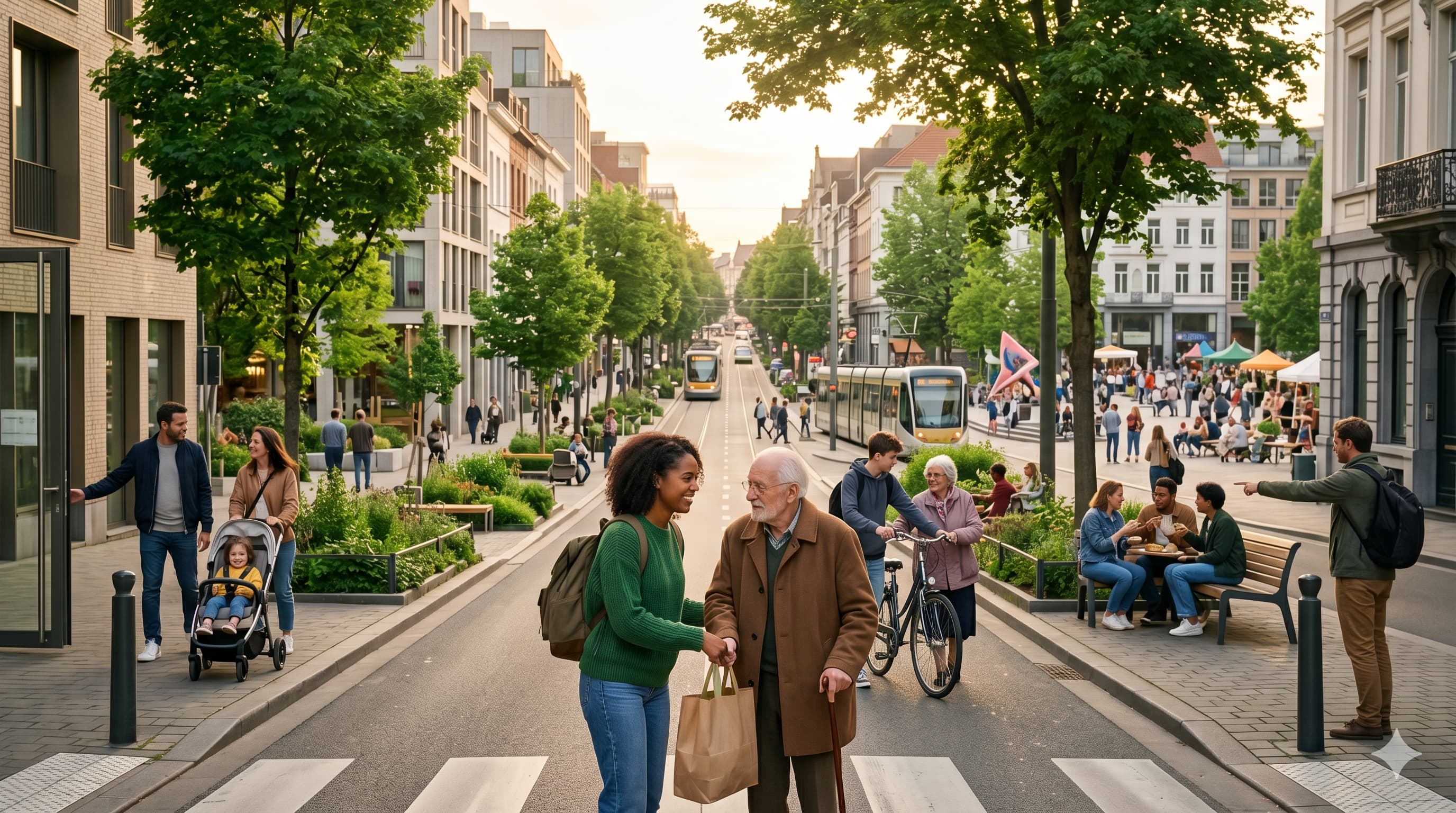
This means: every act of kindness you perform in a public space potentially affects not just the direct recipient, but everyone who witnesses it — and those they subsequently interact with. The scale of one person's influence turns out to be significantly larger than it appears.
Small Acts vs. Big Gestures: What Actually Works
Intuition suggests that change requires large, grand gestures: major donations, large-scale volunteer projects, public declarations. Research suggests something different.
Psychologist Elizabeth Dunn and her colleagues studied "prosocial spending" — spending money on others. They found that the size of the amount significantly less affects the giver's subjective happiness than the fact of the gift itself. A person who spent five dollars on coffee for a stranger received a comparable "happiness boost" to someone who spent fifty.
Another study (Dunn et al., 2014) found: the cumulative effect of regular small acts of kindness over a month exceeded the effect of a single large act with equivalent total spending. Consistency and frequency matter more than the scale of a single action.
Why? Partly because small acts create habits — neural pathways that over time require less and less conscious effort. Partly because they create relationships and social capital that a single large gesture doesn't. And partly because they're visible to more people and create more waves of contagion.
Want to try a systematic micro-kindness practice? Check out the challenges — there are tasks directly related to developing prosocial behavior.
The Karma of the Cumulative: Why Consistency Outperforms Heroism
Productivity consultant James Clear shows in "Atomic Habits" that improving by just 1% every day results in performance 37 times better after a year. This principle applies to prosocial behavior: small daily acts of kindness create geometric growth in social capital and prosocial norms within a community.
Behavioral economics researchers call this "normative cascades": when a critical mass of people begins behaving differently, the behavior becomes the new norm — and others adapt to it. Social norm change happens not through grand manifestos but through accumulated practice.
Philosopher Peter Singer proposed a thought experiment: if you walked past a pond and saw a child drowning, you'd jump in — even ruining your clothes. But why don't we donate equivalent amounts to save children in distant countries when we know it would also save lives? The answer: proximity matters to our moral motivation. Visible suffering motivates more than abstract. But small systematic acts help overcome this myopia.
Structural Limits: When Micro-Kindness Masks Systemic Failure
Honesty is important here. There's a real risk that cultivating micro-kindness becomes a way to avoid systemic thinking. "Better to light a candle than curse the darkness" — a lovely maxim that those in power gladly use to distract from the systemic causes of darkness.
When volunteers distribute food at food banks, this is important and valuable. But it's not a substitute for policies that would reduce poverty. When teachers spend their own money on classroom materials — that's dedication. But it's not a substitute for adequate education funding. Micro-kindness should not normalize systemic injustice by making it bearable through individual effort.
The conclusion isn't to stop small acts of kindness. It's not to let them replace systemic thinking. Both are necessary, and they don't exclude each other.
The topic of moral compass on systemic questions is a good occasion to engage with the Values Compass — it helps clarify where you stand on complex ethical questions.
The Paradox of Anonymous vs. Attributed Kindness
What motivates more: when others know about your kindness, or when it's anonymous? Research shows a surprising answer.
Visible kindness creates a larger prosocial cascade — precisely because it's visible. If no one sees a kind act, there's no contagion among observers, no updating of social norms. Public generosity normalizes generosity.
But there's a risk: when kindness becomes public, it blends with status signaling. A person who publicly donates large sums and ensures people know about it is motivated differently than someone who does the same anonymously. Motivation matters for behavioral durability: research shows that extrinsic motivation (doing for approval) is less durable than intrinsic (doing for the thing itself).
The optimal strategy researchers suggest: mix public and anonymous kindness. Public creates normative waves. Anonymous trains intrinsic motivation.
Practice: A 21-Day Micro-Kindness Experiment
A concrete evidence-based practice:
- Choose one type of action and do it daily for 21 days. For example: every day notice something good in a colleague's work and say it aloud. Or every day perform one small anonymous kind act. Consistency builds the neural pathway.
- Keep a brief observation journal. Not a journal of "what good things happened," but an observation journal of reactions: how did the person respond? What did you feel? Did you notice a ripple effect? This reflective component deepens the experience.
- Vary the types. Different types of micro-kindness activate different aspects of the prosocial system. Alternate: physical help, emotional acknowledgment, material gift, public praise, anonymous gesture.
- Spread intentionally. When someone does something kind for you, tell someone else about it — thereby extending the circle of prosocial contagion.
This connects to gratitude practice — more on the mechanisms of gratitude in a dedicated article.
A few questions for reflection: Is there a small act of kindness someone did for you once that you still remember? What makes a small gesture memorable? Is there someone in your life you should say something good to — and what specifically? Where in your life is systemic injustice masked by the need for individual effort? How would your relationships change if you introduced a daily small kind act practice?
The Biochemistry of Kindness: What Happens in the Body
Prosocial behavior has measurable physiological effects not only for the recipient but for the giver. Research shows that the act of helping another person reduces cortisol levels (the stress hormone), elevates serotonin and oxytocin, and even, by some accounts, reduces inflammatory markers in the blood. This isn't poetry — it's biochemistry.
Particularly interesting is data on volunteering in older age. A 2013 meta-analysis (Okun et al.) found that older adults who regularly volunteer show 22% lower mortality than non-volunteers. The effect persists even after controlling for health, socioeconomic status, and other variables. Researchers attribute this to the combination of physical activity, social contact, and the meaning that helping others creates.
This raises an important question: if kindness is biologically beneficial to the giver, does that make it "selfish"? Philosophers have long debated the nature of altruism. The pragmatic answer: perhaps evolution arranged things so that helping others is literally good for you — because biology thereby ensured cooperation. This doesn't diminish the value of kindness — it simply explains its mechanism.
A final important consideration: micro-kindness has particular power precisely in moments when it's hardest — in stress, fatigue, irritation. Research in positive psychology shows that a kind act performed against the grain of a bad mood creates a stronger neural trace than the same act in good spirits. This resembles muscle training: resistance at the moment of difficulty builds the "muscle" faster. Every time you choose kindness when it's inconvenient or difficult, you strengthen a habit that becomes part of your identity. This is exactly what's meant when people say that character is not what you do on easy days, but what you do on hard ones.
Subscribe to new content
We publish articles about karma, self-discovery and spiritual practices. No spam — only the good stuff.
We never share your email with third parties. Unsubscribe anytime.