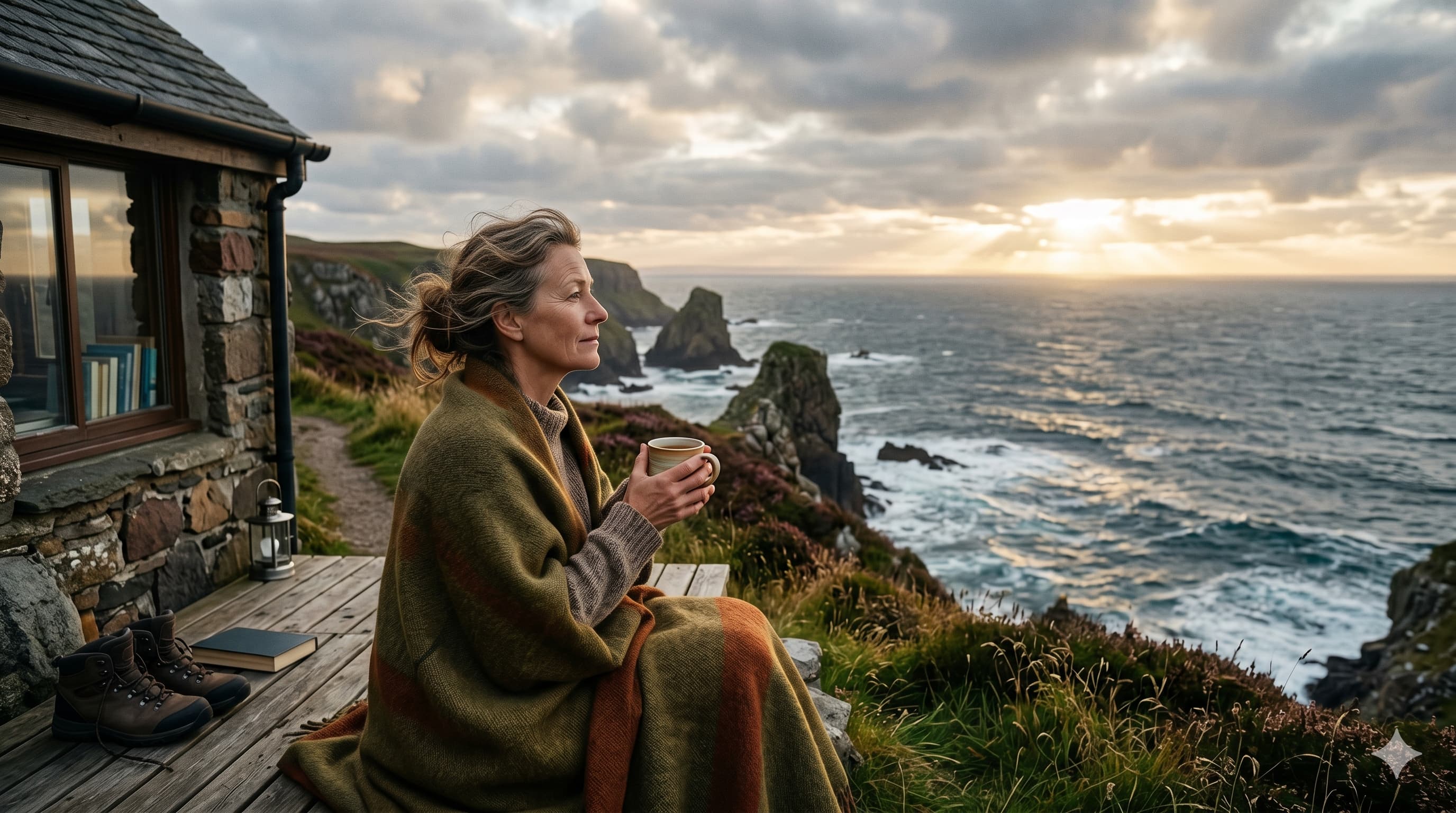
The Karma of Solitude: How Conscious Alone Time Restores the Soul
In a world where being constantly available has become a social norm, solitude has become an almost revolutionary act. Turning off your phone, declining an invitation, sitting in silence without guilt — for many people, this seems suspicious or selfish. But the history of humanity and modern psychology say the opposite: the ability to be alone with oneself is not the weakness of an introvert, but a sign of psychological maturity and one of the keys to a deep, meaningful life.
The Difference Between Loneliness and Solitude
Psychologist Robert Sternberg at Yale University conducted extensive research into the differences between loneliness and solitude. Loneliness is the pain of unwanted isolation — a sense of rejection or invisibility. Solitude is the chosen presence with oneself, which can be deeply nourishing.
The key word is "chosen." It is precisely the element of conscious choice that transforms solitude from suffering into practice. A monk in their cell and an abandoned person in an empty apartment are in identical external conditions, but are experiencing completely opposite inner states. The first is present with themselves. The second is fleeing from unwanted silence.
Philosopher Paul Tillich wrote: "Our language wisely senses the difference between loneliness as pain and solitude as greatness." Solitude requires that you first find yourself — then being with yourself becomes not emptiness, but fullness. Take the karma test to better understand your relationship with yourself.
Why the Modern World Fears Silence
In 2014, Timothy Wilson at the University of Virginia conducted a now-famous experiment: participants were asked to sit in silence for 6 to 15 minutes — no phone, no books. When discomfort set in, 67% of men and 25% of women preferred to give themselves an electric shock rather than remain alone with their thoughts. Some pressed the button multiple times.
This disturbing discovery says much about our culture. We have created a world in which constant noise is a defense mechanism. Notifications, music in headphones, background television, endless scrolling — all are ways to avoid silence. And silence is frightening because within it there is only one thing: ourselves.
Philosopher Pascal wrote three centuries ago: "All the unhappiness of men arises from one single fact: that they cannot stay quietly in their own chamber." It reads almost as a diagnosis for our time. The digital world has made "staying in the chamber" unbearable — and this has karmic consequences.
Read more about digital detox and its effects on the psyche in our article on loneliness in a hyperconnected world.
Solitude as a Spiritual Practice Across Cultures
In virtually all great spiritual and philosophical traditions, solitude occupies a central place. This is no coincidence — it is a deep understanding of the nature of human consciousness.
Christianity: Jesus repeatedly withdrew to the desert or mountains alone before important decisions. The tradition of the Desert Fathers in early Christianity — when hermit monks lived in solitude for years — produced some of the deepest texts on the nature of mind and spirit.
Buddhism: Siddhartha Gautama attained enlightenment under the Bodhi tree in deep solitude after years of practice. Silent retreats (vipassana) of 10 days or more are the primary instrument of Buddhist practice in many traditions.
Sufism: The practice of "khalwat" — solitary retreat — is one of the key methods of the Sufi path. Rumi, the greatest Sufi poet, created his finest works precisely in states of deep inner aloneness.
Indigenous peoples: The "Vision Quest" among many Native American tribes is a rite of passage into adulthood, requiring several days of solitude in nature without food. The idea is simple: to know who you are, you must spend enough time alone with yourself.
Japanese culture: The practice of "kokoro" — "heart-mind" — is deeply connected to cultivating inner space. Haiku, the tea ceremony, ikebana — all are practices of presence that are only possible in a state of inner solitude.
The Karmic Wealth Born in Silence
What exactly happens when we allow ourselves genuine solitude? Why have so many great works, inventions, and decisions been born in moments of silence and withdrawal?
Neuroscientist Marcus Raichle discovered that in the resting state — when we are not solving specific tasks — the brain's Default Mode Network is activated. It is precisely in this network that information is integrated, narratives about self and world are formed, moral reflections occur, and creative insights arise. Archimedes found the solution in the bath. Newton under the apple tree. Not by accident.
Psychologist Mihaly Csikszentmihalyi, author of the concept of "flow," described solitude as a necessary condition for deep reflection: "The most significant moments of my existence were when I succeeded in truly being alone with myself." In solitude is born what he called "autotelic experience" — activity for its own sake, without external rewards.
From a karmic perspective, several important processes occur in silence. First, we hear our own voice — not the voice of social expectations, parental messages, or marketing. Second, we integrate experience: solitude allows us to process what we have lived through and extract meaning from it. Third, we meet what is genuine: in silence, it is impossible to pretend. Ask the Oracle about your inner journey.
How to Find Solitude in a Hyperconnected World
"I don't have time for solitude" is one of the most common phrases of our time. But often this is not an absence of time, but fear or unfamiliarity. Here are some strategies for the modern person:
Small portals of solitude. Solitude does not require a retreat in the mountains. It can be in five minutes of morning silence before you pick up your phone. In a walk without headphones. In lunch without a laptop. These are micro-practices that, accumulated, change the quality of inner life.
Reframing the commute. Many of us spend 30-60 minutes in transit each day. This is a ready-made space for solitude — if you set down the phone and simply look out the window. Psychologist Stephen Harvie calls this "idling practice" — a state of gentle defocusing, extremely beneficial for the brain.
"Technology Sabbath." One day per week (or at least several hours) without internet and phone. This ritual reaches back to the ancient wisdom of the Jewish tradition, but is more relevant than ever. Research shows that even a 24-hour digital detox significantly reduces cortisol levels.
Nature solitude. Nature has a unique capacity to provide "soft fascination" — a state in which attention is gently engaged and the brain is able to decompress. This is the Attention Restoration Theory of Rachel and Stephen Kaplan.
Practice: A Daily Solitude Ritual
Here is a simple ritual that can be built into any schedule:
- Morning 10 minutes. Right after waking up, before phone and coffee — 10 minutes in silence. Simply sit. Notice sensations in the body. What do you feel? What is happening inside right now? Without analysis, just observation.
- Evening "integration pause." Before sleep, 10-15 minutes. Don't look at a screen. Ask yourself three questions: What happened today? What does this mean to me? What do I want to carry from this day into tomorrow?
- Quarterly solitude day. One day every three months — entirely for yourself. No meetings, no plans, no obligations. Something like a personal retreat. This might be a hike, a day in nature, or simply a day at home without internet.
- "Solitude journal." Not a journal of achievements, but a journal of inner experience. Write down what you notice in yourself in moments of silence. Fears, images, insights. This makes solitude conscious and helps integrate what is born within it.
Read more about the qualities of introverts and extroverts in our article "Introverts and Extroverts: A Karmic View."
The karma of solitude shows itself in people who seem like "still waters" in the best sense: calm, deep, stable. They do not react to every wave of the external world — because they know who they are. That knowledge is born only in silence. Allow yourself that silence.
Subscribe to new content
We publish articles about karma, self-discovery and spiritual practices. No spam — only the good stuff.
We never share your email with third parties. Unsubscribe anytime.